

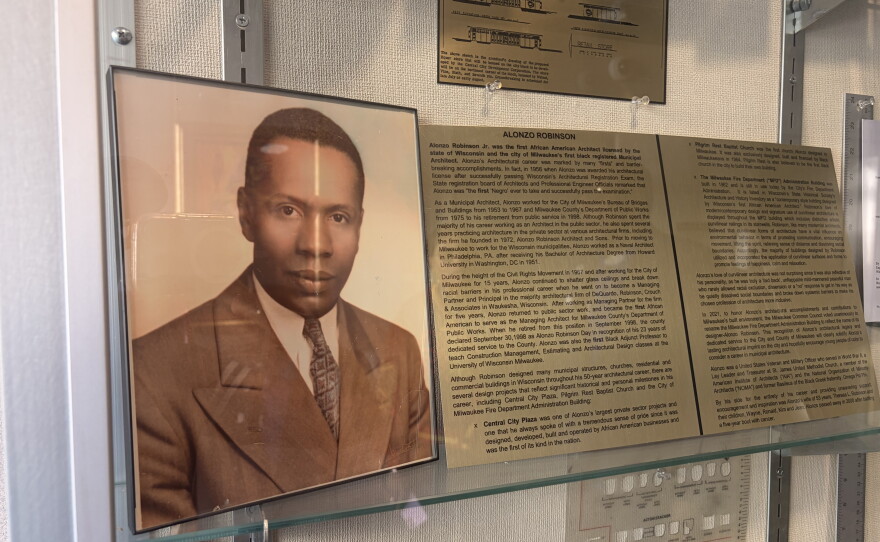
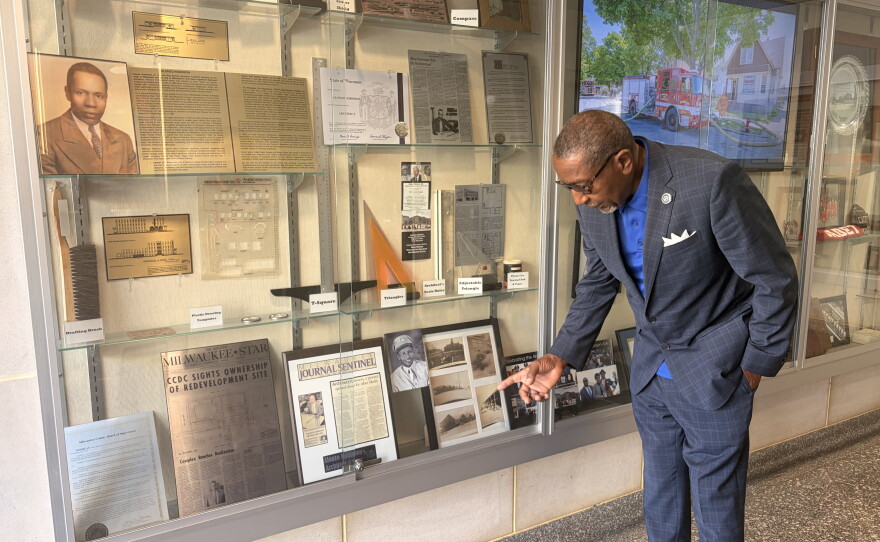
America’s Black Holocaust Museum is celebrating Wisconsin's first Black registered architect with a temporary exhibition called "Honoring Alonzo."
During Alonzo Robinson Jr.’s 40-plus-year career, he designed churches, businesses, public buildings and more in Milwaukee and surrounding communities. Much of Robinson’s work went unrecognized.
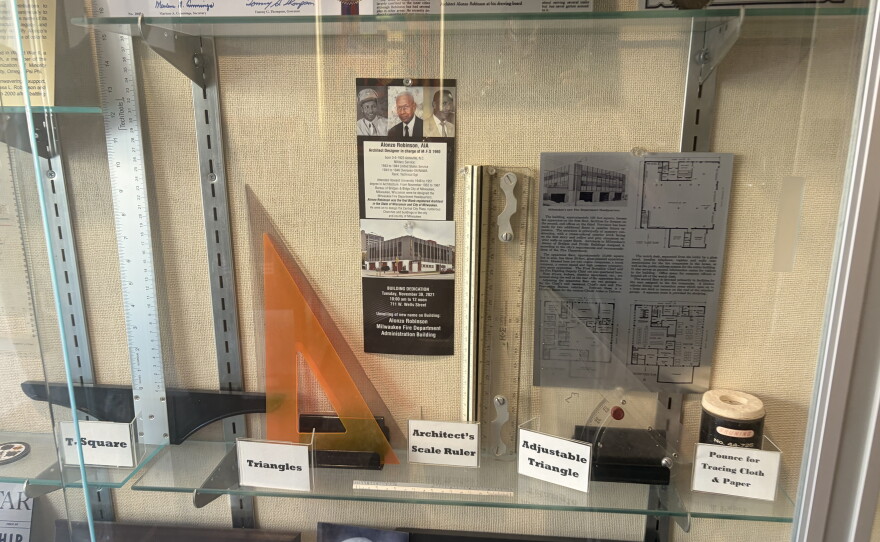
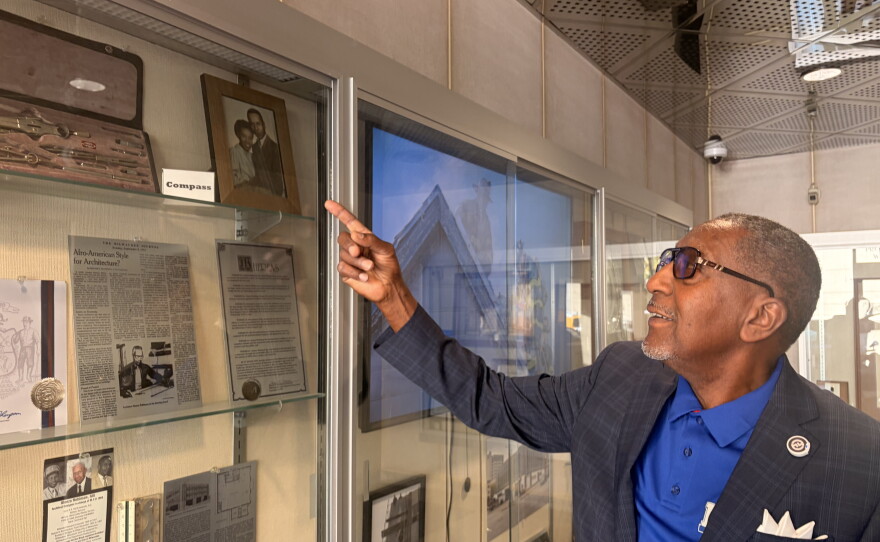
The exhibition seeks to ensure his legacy is not lost. It features a six-panel exhibition about Alonzo’s life, his approach to his work and his projects in Milwaukee.
“We have different panels up of the designs and buildings, and the history and story about my father, Alonzo Robinson," says Kim Robinson Sr.
Alonzo was a modernist architect. His designs incorporated the character that already existed in Milwaukee communities.
His son says one of Alonzo’s most notable designs is the Milwaukee Fire Department Administration Building downtown.
Kim Robinson says he saw the original drawings – thanks to MFD Chief Aaron Lipski – which showed Alonzo’s name on them.
"And so then he gave me the opportunity to go into the archives and look to see if there were any photos of my father at the groundbreaking, but [I] did not see my dad at the groundbreaking, because back in the '50s, '60s, you know, with Jim Crow and segregation and everything, and living in Milwaukee — it was hard as a Black architect to make it here in Wisconsin," Kim says.
Even though Alonzo wasn’t at the groundbreaking, the building’s plans listed him as the “Designer in Charge.”
Kim Robinson says the lack of recognition of Black people’s innovation at that time motivated him to ensure his dad’s legacy was not forgotten.
Kim led the effort to get the MFD Administration Building named after Alonzo; the Milwaukee Common Council approved the change in 2021.
There’s a historical marker outside the building, too.

Another place Alonzo left his mark was as lead designer for the commercial development Central City Plaza at Sixth & Walnut.
The Central City Development Corporation (CCDC) was a Black development group organized by civil rights leaders in Milwaukee to combat urban renewal, which often led to gentrification of neighborhoods and the displacement of residents —especially Black residents.
The Plaza opened in 1973 and was the first shopping center in the state that was Black-owned, operated, and designed.
Unfortunately, due to financial challenges, the complex was sold several years later.
Kim says the site was nearly demolished in 2025.
"But then we brought it to their attention through Docomomo and NOMA that 'Hey, you wanna save these building because these buildings were designed by the first Black architect,'" Kim says.
That same year, the Plaza became a historical site.
Kim pointed to how much people appreciated his dad's work.
"So many people in the community could not afford to hire big architectural firms, so they would come to my father, who had his own, Alonzo Robinson Architect & Son firm, and he was able to do these projects at a low cost for these individuals in the community."
Kim was given proof of the appreciation when he stopped in the Fast & Friendly grocery store one summer and talked to the owner. Alonzo designed that building too.
"And Jim [the owner] said to me, 'Your dad saved my life.' What you mean saved your life? He said, 'When I wanted to build this location for this store, I could not find an architect to design it for me. And they wanted to charge me some astronomical price that I could not afford. But your dad, he was good enough to say, 'Hey, I’ll do it at this cost.' And he was able to get the project done.'"
Kim says it’s important to tell stories like his father’s, and those of other Black people whose accomplishments improved their communities, especially so youth will know their history.

"We can’t let our young youth not know what our forefathers have done," says Kim Robinson. "And that any one of them can be whatever they want to be — doctor, lawyer, architect, engineer, you know. And so, that’s why it’s important that we tell this story and our past will lead us forward into the future."
"Honoring Alonzo" is on display at America’s Black Holocaust Museum until Nov. 7.
Before it ends, there will be a panel discussion at the museum at the end of October, in the spirit of continuing to honor Alonzo.
_


