A Catholic seminary where men "train" to become priests has existed south of Milwaukee for nearly 175 years.
St. Francis de Sales Seminary was established just beyond the shores of Lake Michigan in 1853.
“We're the third-oldest continuous operating seminary in the United States. And we're the oldest using our original building on its original site. So there's an immense amount of history here,” Father Luke Strand says.
He’s the seminary’s rector — that means he’s in charge of the place.
We’re here because recent sounds of construction left a listener wondering what’s happening on the seminary grounds. They asked Bubbler Talk to investigate.
Seminary Woods
Jo Ann Fritz lives nearby too. She loves the 50-plus acre woodland that folds around the seminary’s western edge.
“Our property, our house, our yard backs right up to the grove of trees right near Seminary Woods,” she says.

Jo Ann’s family love hiking it — especially in the springtime.
“I was with my grandchildren, and they saw a skunk cabbage, and it was gorgeous, and I did not know what it was. It was chartreuse and maroon and just coming up. So that was a wonderful way to learn about a new plant,” Jo Ann says.
She worries about rumors that the woods might be lost to development.
“It's such a treasure. It's such gem,” Jo Ann says.

On a recent hike through the woods, Zach Kron concurred — they’re special. He’s a biologist with the Southeast Wisconsin Regional Planning Commission.
“Here’s a state endangered plant: blue-stemmed goldenrod, right along the path,” Zach says.
Trees tower above our heads.
“It is one of the finest examples of beach maple basswood forest that we have remaining," Zach says.
Before Europeans settled here, much of this region was blanketed in forest. Zach says what we see at Seminary Woods are the remnants.
Today, migrating birds, bats, and butterflies refuel here as they travel the Lake Michigan coastal flyway. In spring, ephemeral ponds support everything from wood frogs, blue-spotted salamanders to dragonflies.
Father Luke Strand says the woods also hold spiritual significance. He says St. Francis Seminary has no intention of disturbing or selling them.
“Walking through these woods as we’re walking now puts you in touch with God. The project, as we'll see, is all separate from the woods and the old-growth forest that's here,” he says.
Renovation on campus
Construction is going full-throttle on the seminary’s campus.
Father Luke says the $80 million project is in response to a surge of interest in the priesthood, “We're the fastest growing seminary in the country right now,” he says.
At the same time, the seminary’s buildings were in desperate need of attention, including all HVAC systems, mechanical, electrical and plumbing systems.
“And so we had to do a complete infrastructure overhaul on the main building on Henni Hall, including a new roof and 438 new custom windows,” Father Luke says.
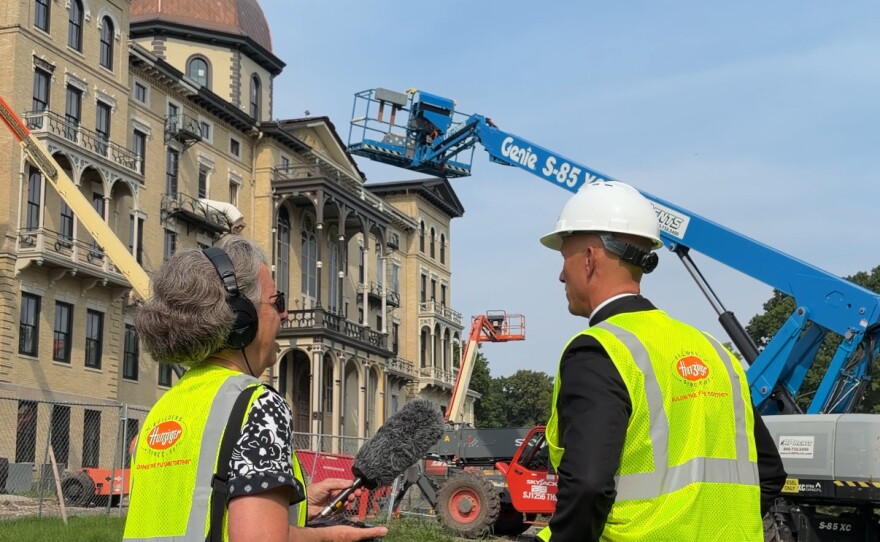
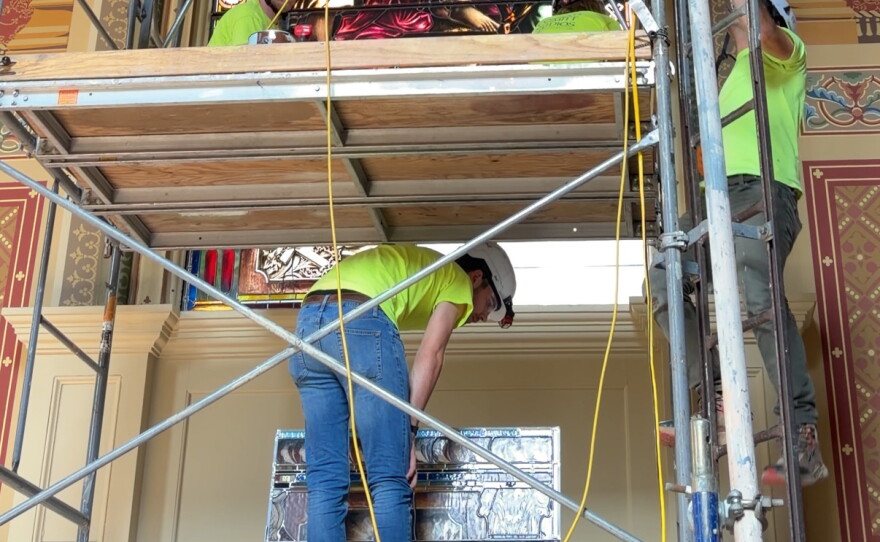
I met with him five days before a construction-related fire broke out at Henni Hall mid-August. Father Luke told WUWM it damaged its front porch but, did not get into the building.
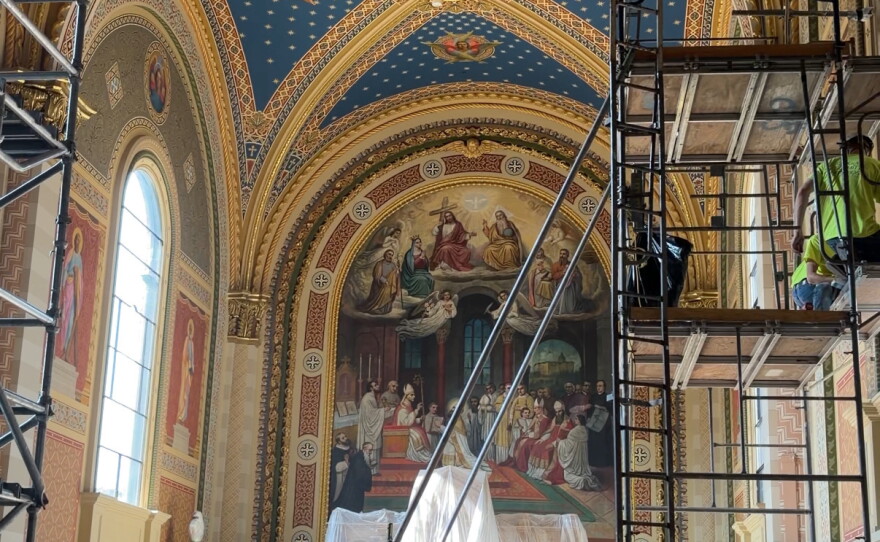
During our visit, artisans buzzed within the chapel located in the heart of Henni Hall.
“We have plenty of documentation from our founders that we never had the money to complete this chapel as they had intended. So our vision was: let's complete it as they intended. We've looked at all of these stencil patterns at Romanesque revival chapels in Europe and then we've recreated it here at the seminary,” Father Luke says.
Our Bubbler Talk listener asked about “a beautiful mosaic wall left over from the old building.” She wondered what’s to become of it.

The chapel where the mosaic was located has been demolished. But Father Luke points to the west end of the campus — where the artwork will live on. It depicts Christ and the 12 apostles.
“[It was] made in Berlin, in Germany, and brought up the St. Lawrence Seaway in the early 1950s, and so we wanted to restore it as an outdoor shrine right on the far side of what will be the new football field,” he says.
It’ll mark the 50-yard line of the field seminarians will play on.
To its south and north stands Seminary Woods. According to Father Luke, that’s not going to change.
_