Climate change has ushered in more erratic weather with occasional torrential storms.
Those storms can cause major problems including flooded streets and flooded basements. Thousands of Milwaukee-area homeowners experienced that first-hand last August.
But in urban, highly-developed areas like ours, creative use of green space – even in smaller chunks – can help absorb and slow the flow of water.
You may be familiar with some of the massive infrastructure projects the Milwaukee Metropolitan Sewerage District has taken on over the years to manage stormwater and reduce flooding. For example, MMSD has removed homes, allowing what were floodplains to function as they did historically, acting as natural “sponges” that absorb heavier rain. And, it creates a natural area for neighbors to enjoy.
MMSD is also deploying another management tool: green infrastructure projects. They’re designed to manage water where it falls — to, as the district puts it, “keep it from becoming someone else’s headache downstream.”
Bre Plier directs the MMSD’s integrated water management program. We met at small plaza that incorporates “green” on the corner of South Fifth Street and West Washington in Walker’s Point. It’s practically in the shadow of I-43 and I-94 heading north into downtown.
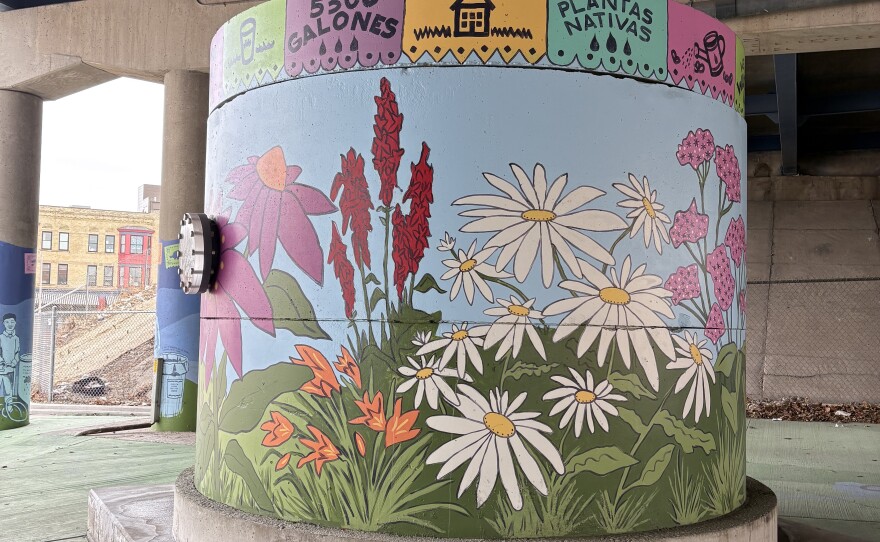
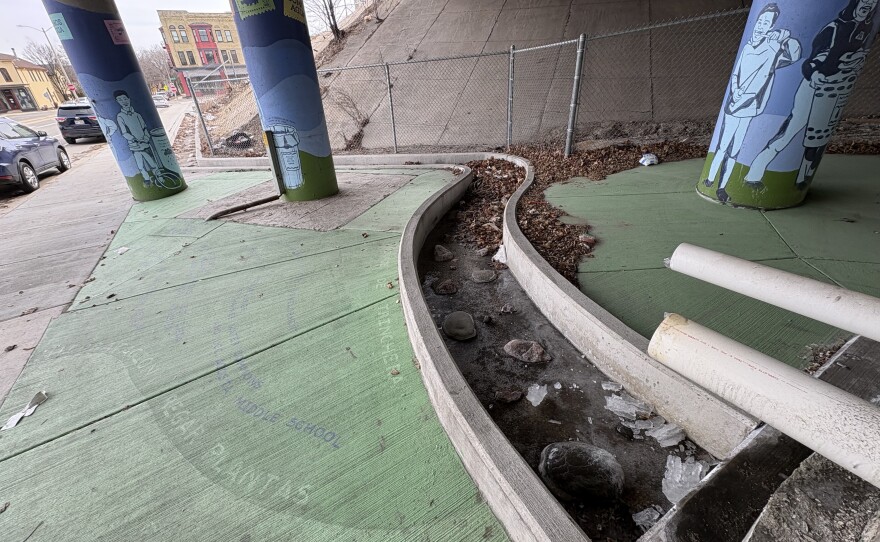

"This is one portion of our Mineral Street Overpass Green Infrastructure Project," Plier says.
The system is designed to collect water as it hits the freeway,
"So, we disconnected several of the downspouts off of the freeway overpass and those are going into rock-lined swales that are then directed into, like, what you see here," Plier says.
What makes this green is a huge rain garden that is 39 feet in diameter. It’s studded with native plants. Beneath the plants and soil are layers of pea gravel and crushed stone. The system slows and holds water.
"This project in total can hold up to 145,000 gallons in any given rainstorm," Plier says.
There are several other freeway projects and another in the planning stages near the now-closed Holt Ave Park and Ride.
Plier says the MMSD is using a variety of green infrastructure approaches — large like this and small ones — all to capture, absorb or store rain and melting snow. Things like green roofs and porous pavement in parking lots.
"We still do rain barrel workshops. So those are 55 gallons. [A] lot of bioswales in city medians. Permeable pavers in parking lanes or like the permeable pavers you see here in this square," Plier says.
Flood management is just one benefit of green infrastructure. The huge rain garden here in Walker’s Point also captures the first half inch of rainfall flowing off the freeway. Plier says capturing that first half inch is crucial.
"It’s usually the dirtiest," she says. "It’s picking up all the dirt and debris, stuff leaking from cars. So we want to slow it down, filter it out to help water quality but also help conserve capacity in our sewer system during rainstorms."

But there’s more to green infrastructure projects than designing and installing them. Maintaining the “living system” — the plants — can be a challenge especially in sometimes brutal conditions, including erratic winters.
That’s according to Tony Parolari, associate professor of water resources engineering at Marquette University.
"They’re living systems made of plants and soils and the soil microbiome. And so they respond to variations in temperature and variations in soil moisture and the pollutants that come into the system," Parolari says.
Some winters, crews apply a lot of a road salt. Parolari learned when it accumulates it can create a cement-like seal "on the soil surface that prevents infiltration. So, we studied a dozen systems in the Milwaukee area and we found that there is an impact," he says.
Parolari says planning for the future is complex.
"And there’s quite a bit of uncertainty about how the climate will change," he says. "I think part of the challenge is thinking about how do we design something now that can perform under this wide range of conditions or how do we make decisions under what they call ‘deep uncertainty.'"
Parolari and his students came up with an evaluation tool to help MMSD strategically plan where to place future green infrastructure projects.
By the year 2035, MMSD hopes green infrastructure will be able to capture the first half inch of rainfall across impervious surfaces throughout the district’s service area. That would add up to 740 million gallons of stormwater.
Plier says the district is nearly a quarter of the way toward that goal now.
Editor's note: This story has been corrected to reflect that MMSD’s goal to capture the first half inch of rainfall in its service area would total about 740 million gallons.
Have an environmental question you'd like WUWM's Susan Bence to investigate? Submit below.
_