A Milwaukee County Circuit Court judge could decide next week whether Shorewood resident Paul Florsheim was trespassing when he walked on what the village considers to be private property.
Florsheim was ticketed for strolling along the shoreline north of Shorewood’s public beach, where private homes are built above on the bluff.
He fought the citation, arguing the public has the right to access the shoreline.
This feels like an interesting time to bring up a challenge that came up a half-century ago, on Geneva Lake — 50 miles from Milwaukee.

Ginny Hall wrote a book about walking the Geneva Lake shoreline. Well, not exactly a book — a series of informative pamphlets. They describe the footpath and the magnificent mansions that share its shoreline.
“The path is around 21 miles," she says. "You’ll find experts who differ [on] mileage, but I’d say it's around 21 miles. I know people do that all in one day, but then you don’t have time to look at the scenery, enjoy the views and enjoy the architecture of the buildings along the way."
Hall was the Walworth County Extension home economist for years before becoming a Lake Geneva Public Library volunteer. That’s when she picked up a pen and began chronicling local history, including the lake footpath.
“You can’t walk across people’s lawns unless you’re a part of that family or a good friend of the family. So, it was divided into where you can legally get on the path and also can legally park your car,” Halls says

At each public access point a sign reads: You are invited to walk along the lakeshore path and enjoy the natural beauty of the Geneva Lake shoreline.
But of course, long, long before that invitation was extended, Indigenous people — from the Oneota to the Potawatomi — walked the path, fished the lake’s waters, farmed and raised their families in nearby villages.
Hall says that history deepens the significance of the footpath.
“It’s not just when the white man came to the area; it was open well before that time,” she says.
Mansions began to spring up and multiply along Geneva Lake after the Civil War, when wealthy Chicago families gravitated there.
Hall says it takes her breath away when she drinks in a 40-acre estate designed by the sons of famed landscape designer Frederick Law Olmstead.
“Makes me think of 'Gone With The Wind,'” she says.
Another mansion boasting 50 rooms is significant for more than one reason. Hall says Otto Young was a “rags-to-riches” immigrant. He built what was known as his “Italian marble palace” for his family in the late 1890s.

“The Stone Manor — and the young family enjoyed it for a number of years,” Hall says.
Stone Manor has had a multiple lives since then, including as an Episcopal girls school for a time, but also briefly a restaurant.
Its owner, John W Bihlmire, created quite a stir in 1974 when he didn’t want the public to walk across his property. So, he locked gates to block the stretch of the footpath that passes Stone Manor.


Hall says a year later, a circuit court judge ruled that access to the foot path could not be restricted.
"Because that was a path that had been open for public use from the time of the Indians," she says. "And so it was determined that that was a public fairway and could not be blocked off."
On a recent weekday morning, I met Chicago-area resident Cathy Bollin as she and her family were about to set out on their annual Geneva Lake footpath hike.
“This is our seventh year. Before that, I would walk by myself or I would bring Harrison with,” Bollin says.
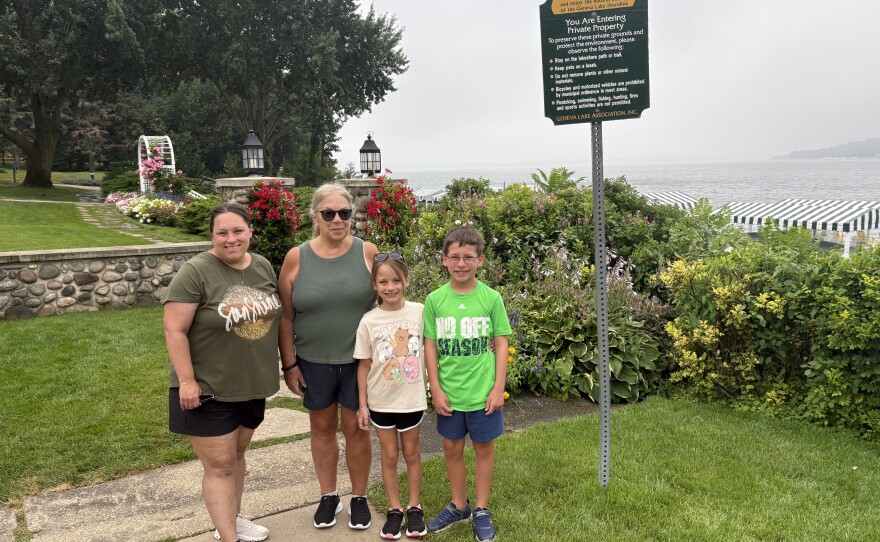
Harrison is her 10-year-old grandson. “I like it because it’s a great exercise in my life, walking past the waves on the lake, because I think it’s very satisfying. But my least favorite part is all the exhaustion,” he says.
Harrison's younger sister Harper chimes in: "It means much to me because I get to be around nature and I get to be with my family and I get to walk through all these paths and it’s so fun."
Cathy Bollin hadn’t heard about Paul Florsheim, the Shorewood man who’s challenging the trespassing ticket that he got for walking along Lake Michigan.
But Bollin has an opinion about whether people have the right to access the Great Lake’s shoreline.
“It’s unbelievable to me, because we can walk literally from Rogers Park to downtown Chicago along the lake when we’re there. So we don’t know any different growing up that way. I love that they do it here,” Bollin says.
And then they were off on their Geneva Lake trek, despite the gray, muggy weather.
WUWM will continue to report on the Paul Florsheim’s Lake Michigan case. His day in Milwaukee County Circuit Court is Aug. 13.
_