

Ballroom, or ball culture, is an LGBTQ+ subculture involving pageant-style performances.
Participants compete in lip-sync, dance, model or “walk” categories, imitating traditional masculine and feminine gender constructs, and social classes, for example.
"People forget balls originated as a way for people to dream of being something bigger than they are. I can be an executive in my suit and tie. I can show my realness, my butchness, my femmeness and still win these trophies and have it all. And be something for a minute or two that society won’t let me be," says choreographer David Roussève.
With a few days left before opening night, he looked on as dancers rehearsed his dance-theater work, which showcases Ballroom culture.
It’s called CARE: Illuminating Milwaukee’s Queer and Trans Communities.
The earliest example of drag balls can be traced back to Harlem in 1869.
Ballroom’s more recent history began to take shape in the 1960s.
That’s when Black and Latino queer and trans folks created Ballroom culture as a response to racism and exclusion in mainstream society — and in drag spaces.
They formed “Houses” — which are chosen families — to compete for trophies. The Houses also are supports for those who might be estranged from their birth families.
Roussève says he loves how Ballroom culture redefines family and opportunity. So, when he was commissioned by UWM’s Peck School of the Arts to create a piece for the Winterdances concert, he took it as an opportunity to spotlight Ballroom — and the BIPOC LGBTQ+ community.
Roussève spent a year doing research, working with UWM students and the non-profit organization Diverse & Resilient.
He wanted to learn about Ballroom here, and the local LGBTQ+ community.
"They kept saying, 'Well, it’s a really segregated city. Well, there’s a big LGBTQ community, and there’s a big Ballroom community.' And I thought, 'Oooohh.' Well, at this moment in time, this might actually be the moment to work with Ballroom ‘cause I’m sensing things are getting rough for us again in terms of oppression," Roussève says.
Roussève says Ballroom redefines the ways that communities under assault care for themselves, without worrying about what the powers that be will do.
The cast in his dance-theater work includes local Ballroom members and UWM dance students.

"There are these three voguers who walk into this ball — a debutante ball — there’s a mostly white debutante ball happening," Roussève describes the storyline. "And the premise of the piece is the voguers walk in on that thinking, 'Isn’t there a Ballroom happening, a ball?' And the leader of the deb ball says, 'Yes, a debutante ball.' And they’re like, 'Oh, we’re here for a Vogue Ball girl!'"
In the scene, the cast freezes at the sound of a camera shutter. The screen on stage then displays a description of a traditional debutante ball.

Then the cast is live again.
When the voguers explain that they're there for a House Ball, a camera shutter sounds again. The cast freezes and the screen displays a description of a House Ball.

The text explains that House Balls are LGBTQ+ convenings with performances that comment on race, class and gender and historically reflect the American Dream and one’s exclusion from it.
The initial friction is resolved when the Ballroom performers and the debutantes begin dancing together.
"And so, by the end these two completely separate aesthetically, kinetically, thematically, racially — they’re all jamming together and doing really beautiful vogue-inspired and pure vogue," Roussève says.
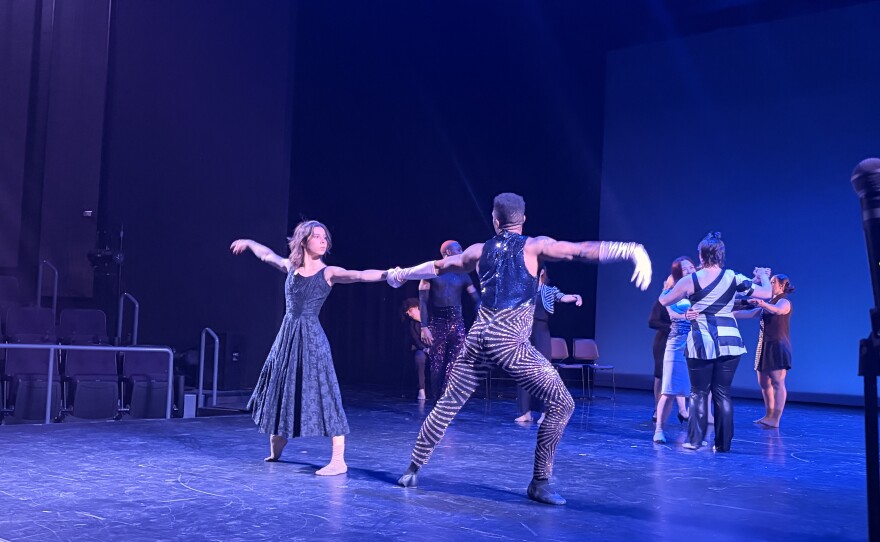


Roussève says it was important for him to have everybody doing pure vogue, and celebrating it on the same level he says people celebrate ballet.
"So, it’s about communities coming together and learning that: hey we’re not so different. And actually, learning to love each other. And then learning to celebrate a form that is not your own; that you have been generously invited into," he adds.
Roussève says putting this show together was a highlight of his career.
He describes what he wants the audience to take from the performance:
"If people can recognize the joy of ballroom and the joy of these two otherwise separated communities, what they’re getting out of coming together, they’re stronger as a whole. That's what I would love for them to take — is an awareness of the other, and awareness that the other ain’t that scary," he says.
And, Roussève wants the audience to experience some fierce dancing.


