

The Oriental Theater on Milwaukee’s east side is the only cinema in the city (and one of less than 20 in the entire country) that can show film year-round.
This is thanks to not only restoring and maintaining specialized equipment needed to present film, but also because of the theater’s dedicated projectionist team.
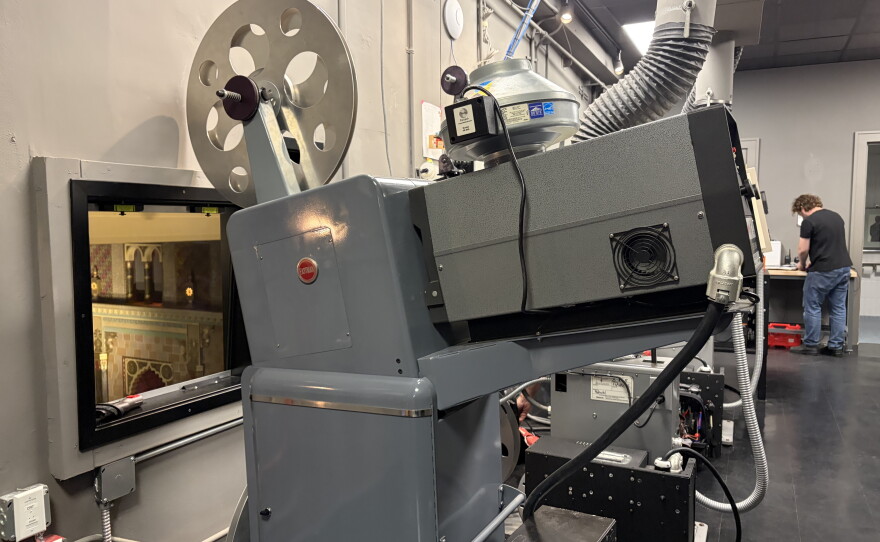
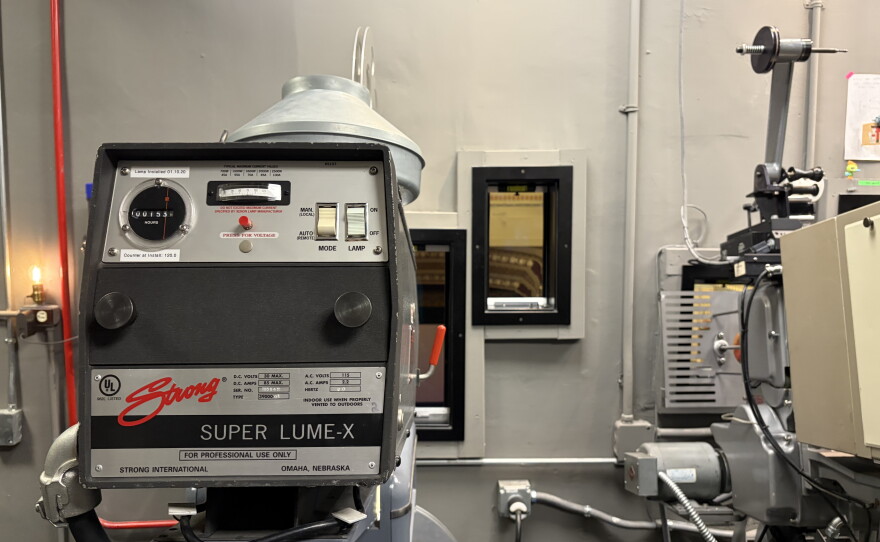
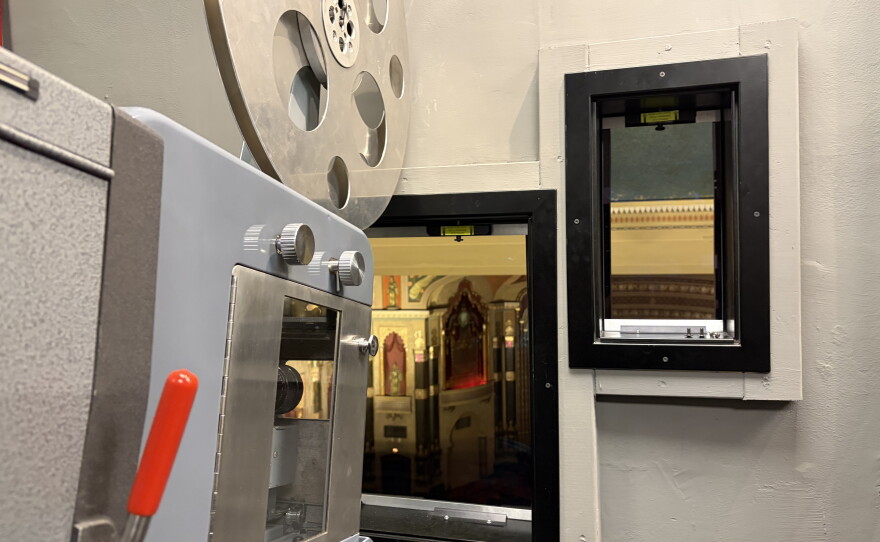
If you go up several flights of stairs to the balcony of the Oriental, you’ll find a door that takes you to the tech booth. Looking around at all the specialized equipment and workbenches, you can tell that the work of a projectionist is more of a precise science than you might expect. It’s time consuming, detail-orientated and often anxiety inducing work to make each reel of film look as good as possible.
"It’s kind of the unfortunate nature of being a projectionist is that I think you’re always really hard on yourself about the presentation and always wanting to improve on it," says Milwaukee Film's technical director Kevin Rice. He's one of four dedicated staff at Milwaukee Film who run and take care of the projection equipment.
When the job is done right, a good projectionist is more like a little shadow in the upper balcony who audiences don’t even notice because they're engrossed in the film being presented in real time. It’s an old school, legacy labor job that a group of four people, including Rice, are keeping alive right in our backyard.
"People already know about digital and video technologies but when it comes to celluloid presentations, film comes in a variety of different gages, and the gage is the width of the film," Rice explains. "So there can be gages of 8mm, Super 8mm, 16 mm, 35mm, 70mm, and a few others, but those are the real common ones."

Celluloid is a physical material made of a flexible plastic base, and on top of the base is a photosensitive layer called the emulsion that comprises of many different layers for color film according to Rice. "Within each of those there's also actually three separate ones for a slow, medium, and fast versions of those. So there's a good 20-ish or so separate layers of emulsion basically coated on top of the film," he adds.
Currently Milwaukee Film is presenting a whole 70mm film series through Sept. 4, which is "very rare" for commercial theaters. "Of course there's been a lot of art house cinemas that have held on to it and have preserved the craft," notes Rice. "A lot of the capabilities kind of faded away in the era where platters were a common occurrence for how films were ran. The Oriental was a platter house and eventually, of course, a digital house and they kind of stopped projecting films in general. When we started the operating the Oriental, we restored one of the machines here and then we installed another machine so that we could do reel to reel, which is important because that's really the only way that you can show films from an archive or from distributors these days."
There is a lot of care and coordination that goes into showing film, whether it is archival materials or new releases. For example, the Oriental Theater is going to be one of about a dozen cinemas in the country that will be showing Dune 3 on 70mm. For the week-long film series, the projectionist staff had to wait on several deliveries of film reels — some weighing up to 50 pounds. They have to be carried up several flights of stairs to be stored in the tech booth above the top balcony of the main theater. Once they're up there, Rice says that's when the inspection process begins.

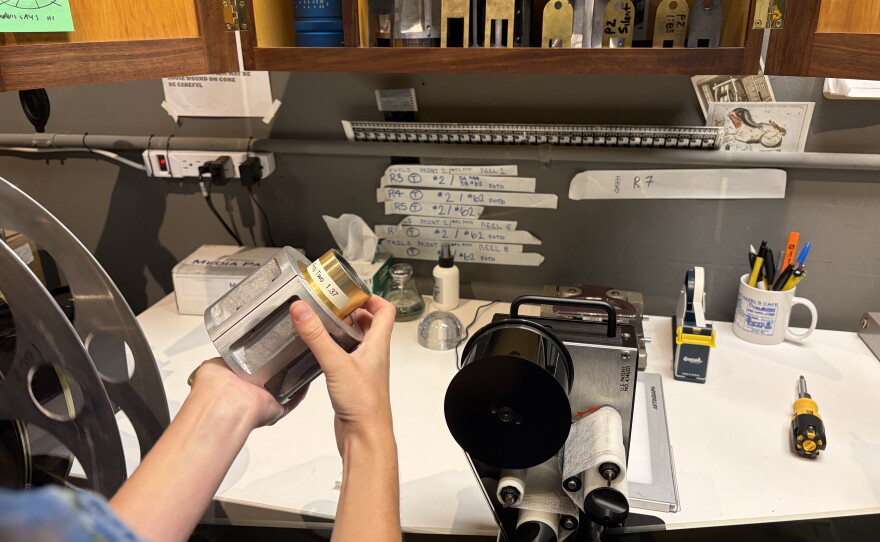
"What we're looking for is that they're actually show ready, and that involves a few different things. Part of it is looking at the condition of it, but sometimes you don't really have a say in the condition or the print. But we have to watch out for very critical things like, for example, sprocket holes in the film have to be perfect and not torn or distorted or anything like that — that would cause a disruption in the screening," he notes.
The team also documents the condition of the print as it arrives and check the heads and tails of the film, "because we are a reel to reel house and the changeover process is really critical," adds Rice.
Something the projection team does during inspection is look at the changeover cues in the reels and create sketches of the film cells where the changeovers are going to happen during the screening. It's similar to a storyboard, and it's a creative way to really engrain what exact scenes to look out for in the changeover process.

If you're a diligent viewer, the cues can be seen for just a moment in the upper right-hand corner of the film when it's being projected. But before people see it on the big screen, Rice and his team look for the cue marks that are scribed, burnt in, printed, or simply marked up with a grease pen.
"The older the prints, definitely the greater the variety. Newer prints are almost always printed in," says Rice. "As a projector, you're going to be standing close by to the motor switch for the next projector, and as soon as you see that cue mark, you hit the motor and at that point the projector needs to get up to speed for the actual changeover. So it's really critical that you hit that one because the film on the next projector really needs to get to the exact moment for the changeover as well."
Rice says every projector has its own personality and characteristics, and through the years they've done a lot to learn about what makes their machines work well.
"We'll kind of test out the changeovers and kind of see how they feel, if they feel like they're a little bit early, a little late or something like this and we will try and dial it in as much as possible which sometimes requires manually changing exactly where we thread up into the machines for a particular print," he notes.
With so few places still showing films regularly, there is no boot camp for projectionists to go to. Rice says they learn through working with others and putting a lot of hours into the craft. "This is knowledge that has been passed down from a lot of really knowledgeable people," he says.
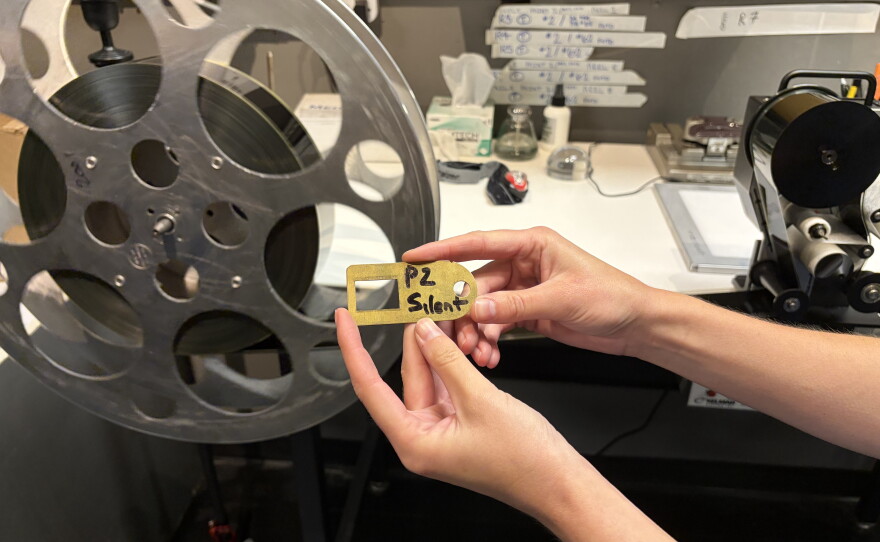
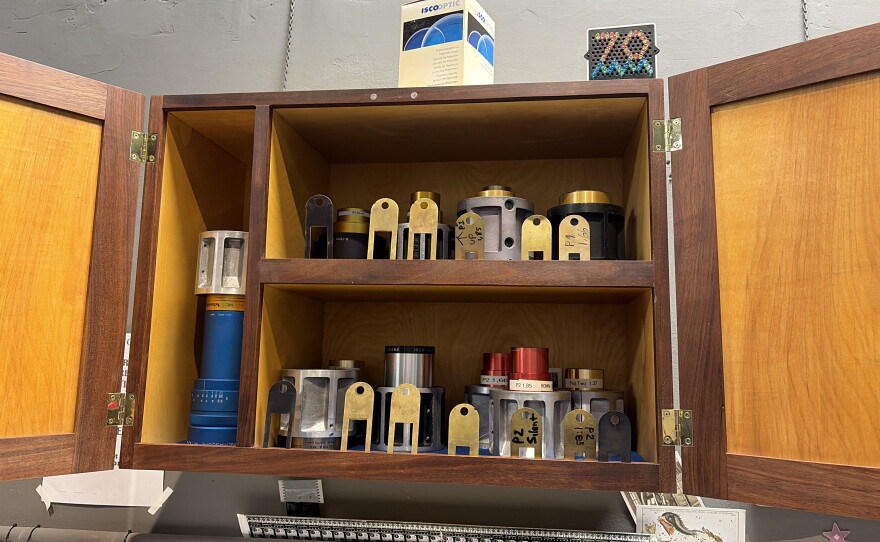
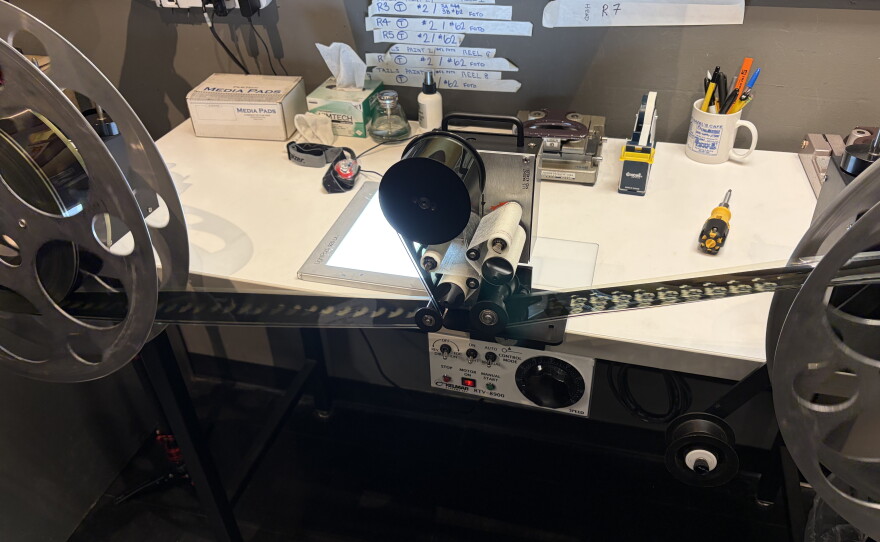
Rice notes that celluloid film in general has a very intricate nature, and being a projectionist means embracing the "constant struggle that you're fighting against, but always improving and perfecting upon." While there are lots of comparisons about the different technical aspects of film presentation, what is important with film is that you are not just watching a film, you're seeing a performance of projection by a human being behind the scenes.
As much as the job is a constant challenge Rice, he says his favorite part about it is the takeaways he gets beyond the booth.
"One of the things that I've always loved about film in general is that it's one of these things that as you get more absorbed in, you realize that it's kind of an analog for many different things in life and you kind of begin to find out that you need to understand a lot of things that you may not have commonly have associated with film," he says. "We need to start learning mechanics and chemistry and how acoustics work and it's really a whole variety of the things that kind of just make up our world. So as you kind of get a little bit more dedicated and lost in it, you really start to learn all kinds of things that you wouldn't have ever really expected to learn and that's what's wonderful about it."


