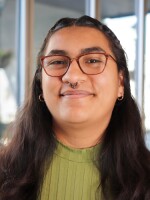
Migration can define generations. Moving to a new place forces families to change as they choose what to pass forward, and what to leave behind in the name of adapting to their new surroundings.
Artist Christie Tirado's life is defined by migration. Her parents grew up in neighboring towns in Mexico but met after they both immigrated to California in the 1980s.

Tirado grew up in the U.S. but traveled to visit family in Mexico every couple of years. On these trips, she became fascinated with how culture is passed down.
For the past three years, she’s been traveling to Tarimoro, Guanajuato, visiting her grandfather and her father’s rancho, La Cañada de los Tirados. She’s been collecting stories — little moments that make up a life.
“There's these stories of my grandparents, you know, harvesting their guayaba and then taking their guayabas in the crates and going to the mercado and selling their guayabas in the mercado and then not going back home until all those guayabas were sold,” Tirado says.

She used those moments as inspiration for her art. Now, Tirado’s intricately carved relief block prints are featured in an exhibit called “Cosechando Historias,” showing at Milwaukee’s Latino Arts gallery.
“You pick up on things that are very subtle that feed into and make up who you are, and a lot of those things are your family's background, where you're from, certain mannerisms that you're just like, ‘Why does my mom act this way?’ And it's like you go back to her rancho or her community and you're like 'Oh I see my great aunt or so and so acts the same way,'” Tirado says.
Tirado’s father came to the U.S. looking for better economic opportunities. Her mother accompanied her mother to a new country at only 16 years old and began working in a garment factory. Her parents met while living in Los Angeles.
Tirado was born in California, but her family moved many times, following work opportunities until they finally settled in Tacoma, Washington. Tirado is now pursuing a master's in fine arts at the University of Wisconsin-Madison. She put together this exhibit for her thesis.
“Even if I'm here in the United States, but also growing up in a space where my mom made those dishes and when I would come home, those were the smells that envelop my house. But then also going back to Mexico and smelling those same scents — it's just something that took me home even if I wasn't necessarily home," says Tirado.
Tirado carved their stories into blocks to create prints and mixed media pieces. They’re personal, but they also reflect larger themes of migration, labor, and the passing of traditions.
Some of her creations covered the walls from ground to ceiling, bringing Guanajuato's countryside to life. Others are the size of a tiny book that fits in one hand. Orange and black butterflies speckled the gallery floating between Tirado's work.

Tirado gave students from Whitnall High School a tour of the gallery. She first led them to a print of a man. He was pictured sitting, peeling a pomegranate, with the seeds spilling on the ground beneath him.
It was Tirado's father — a moment she captured while in his rancho. The print is accompanied by a poem she wrote, “Las manos de mi padre.” She likened the work he’s done around the United States to the seeds of the pomegranate he held.

Like the seeds, her father left scattered stories and memories in the wake of his labor. In Los Angeles, he sewed clothes. He worked in a meat processing plant in Minnesota. He drove greyhounds between Tijuana and San Diego. Those are just a few of the jobs he’s held.
“I feel like being the daughter of Mexican immigrants, labor was just a huge component in the way our family interacted with one another," Tirado says. "The absence of having my father working all of the time — that's the reality for a lot of first generation families or families that immigrate here."
Tirado’s work is about the physical labor her parents did to earn a living. But it’s also about the labor of love and what it means in a domestic space.

“I was spending a lot of time with my madrina, making traditional dishes and cooking the meals for the day and it was in those spaces where I was getting a lot of the stories from my family...by helping out with the process of creating these dishes," says Tirado. "Not only was I learning these specific dishes, but I was also essentially given permission to learn more about these stories that are very internal, or very intimate, about family members and even from my parents that I didn't even know.”
Her artwork replicates those memories spent in the kitchen, cutting tomatillos, making tortillas and salsa with relatives. These simple moments drawn, pressed and printed onto different materials capture how culture is transferred from one generation to the next, like ink transferring onto paper.
Tirado stopped in front of a piece titled “Salsa.” It’s a book created using lithographic printing to document her family's recipe of salsa de tomate. She talked to the students about how, due to migration, sometimes recipes aren’t passed down. They’re lost for future generations.
“When you come over here, there's also that conversation that happens with a lot of first generation where it's like, 'estás perdiendo el idioma,' or you're losing your language," says Tirado. "By losing quote-unquote that language, you're essentially losing some of those stories that are told in that language as well.”
Towards the center of the gallery was a tortillero, a simple woven basket, lined with a cloth, that typically would hold tortillas every night for dinner.

Instead of holding tortillas, it held pieces of paper made of cornhusks with imagery of corn kernels and a woman using a metate, a traditional tool used to grind ingredients. It’s a labor-intensive process that’s not lost on Tirado, and reflected in the medium she chooses to tell her family's stories.
“A lot of my work has to do with process. I mean, print making is very process-oriented, and it's also very labor intensive," Tirado says. "When I'm watching my madrina make tortillas and then I go in and attempt to make them initially, it's like they don't turn out the way you expect them to. You're like, this is not round, this is something else, and it's stuck, and there's this care and there's this this touch that goes with it, right?”
Tirado’s work holds stories that are similar for many immigrant communities whose identity is molded by their migration and labor, but her message of looking deeper into your family history is not reserved for immigrant families.
“I want people to think about their history," says Tirado. "Think about what are some stories maybe that some of the people around you — maybe your elders — have told you that are not recorded.”
“Cosechando Historias” is a call to action to remember those who came before you and consider what you pass down to the next generation. It's on display at Latino Arts through June 5.