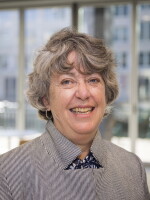
The dean of UWM’s School of Freshwater Sciences is stepping down for a new job.
Rebecca Klaper was a founder of the freshwater sciences school and served as its dean for three years.
For more than two decades, she’s researched emerging contaminants in freshwater, including the impacts of pharmaceuticals and PFAS on environmental health.
Last week, she became dean of the University of Delaware’s College of Earth, Ocean and Environment.

In a conversation with WUWM reflecting on her time in Milwaukee, Klaper said she is proud of the School of Freshwater Sciences’ evolution.
“We started out with a graduate program where we had traditional master's and dissertation PhDs and professional master's programs. So those folks are potentially returning from other jobs, or out of their undergrad, and want to go and work in the water industry,” she explains.
“And from that, over the years, people were asking 'Why don't you have an undergrad program?' And so just in the last five years we started an undergraduate program...I'm really excited to see where that goes. It's really a young program,” Klaper says.
She says the key is introducing students to the water science careers that are out there.
“The fact that you could be a scientist in a lab, you could go out in the field and look at fish populations. You could be helping people make a better water filter or putting water technologies into industries and people's homes,” Klaper says.
Over the years, Klaper’s research of emerging contaminants led to collaborating with fellow scientists around the country and advising government and research organizations.
“The International Joint Commission, EPA, the National Academies often pull scientists in to talk about the research that they've done and what they know about the field, to help them make policy decisions," says Klaper. "We really present what the evidence has suggested so that policymakers can make an informed decision."
Nurturing future scientists has meant a lot to Klaper. She's continuing to advise one former student, Eric Ostovich, on a business called Built-N-Bioassays.

As she transitions to her role at the University of Delaware, Klaper will no longer be steeped in research or work directly with students.
“I wouldn't do students justice at this point if I was focusing on an administrative role while trying to advise students. The role as a dean is really one of support and trying to gain resources and managing an organism — essentially an ecosystem of people —that are trying to move a ship forward,” Klaper says.
A Women in Academics report included Klaper in a roundup of seven women who have been selected for dean positions around the country
Klaper is encouraged, but says female scientists still face challenges.
“But I do feel like this place in particular has been supportive," she says. "Former dean Val Klump, who is great — one of the reasons I took the job here was I was thinking of starting a family, and I was worried about becoming an academic. And he came out and said, ‘Hey, if you can't have a family and have this job at the same time, then we are doing something wrong.’ And I took that to heart as an amazing thing for someone in his position to say. And I, of course, want to foster that wherever I am."
As Klaper takes on her new position, she says her love of the Great Lakes will remain constant.
“One of the things that first struck me when I came to Wisconsin, it seemed water and environment crossed the aisle of the political spectrum, which just amazed me,” Klaper says. “I hope it can serve as a model for other things that we can all come together on. And really, as a state, we keep protecting this resource. It's really important.”
_