

Climate change is leading to more extreme weather, including heavy rainstorms.
Communities around southeast Wisconsin are trying to find ways to better manage stormwater and reduce flooding. Ozaukee County is turning to green infrastructure techniques within its parks.
Preventing erosion and flooding at Virmond Park

Ozaukee County's Planning and Parks Director Andrew Struck shows me what's happening at Virmond Park.
The views are dazzling. Lake Michigan glistens beyond the bluff hugging the shore. We head north along a wooded path. Water puddles beneath our feet.
“We have bluff-top wetlands just 100 yards from the edge of the bluffs," Struck says. "They’re super important habitat. We have some very unique species of salamanders that use these wetlands."
Struck points to 30 acres of restoration to the west.
“We’ve restored native prairie, woodlands and wetlands,” he says.
The restoration is about more than enticing salamanders to the park. It’s designed to move water away from the bluff.
“[Because] the bluff is very, very dynamic. [It] slumps, slides etc.,” Struck says.
Natural forces like ice in the winter or strong currents buffeting the shore contribute to erosion. But so does the stretch of wetland 100 yards beyond the bluff.
Struck says that’s because of what’s happening beneath the wetland surface. He compares it to a layer cake.
“You have these big layers of clay, you know, your main cake material, and then you have little sand lenses that are like kind of the cream filling or whatever running through the layer cake. And then you have another chunk of clay and then another sand lens,” Struck says.
So while the wetland holds water for a long time, when it does percolate down into a sandy layer. “Those sand lenses take the water out towards the bluff. That’s where you get some of that contribution to erosion,” Struck says.
And here’s where the human impact comes in.
“Virmond, while it’s 63 acres — a fairly large park — it’s built up on all sides. So residential development to the north,” Struck says.
The wetland naturally drains to the north. “And it used to drain...into a ravine. That was cut off,” he says.
Struck describes what resulted as ponding. Basically, the water builds up. “We were getting ponding at the far north end here,” he says.
And with more frequent and intense rainstorms, ponding has intensified, ”like five feet of depth of water very close to the house foundations,” Struck says.

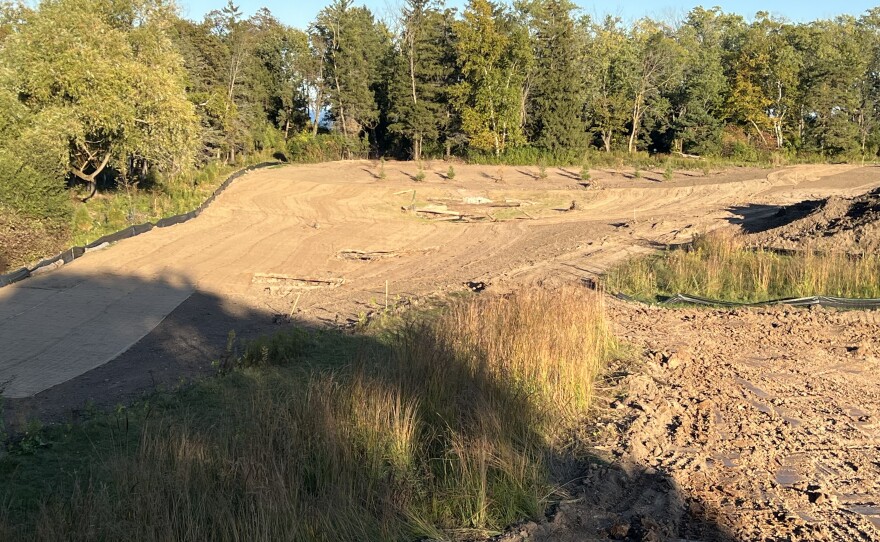

The 30-acre restoration is turning what was mowed grass into a series of wetlands that flow into prairie, so the rainwater has a place to go.
“We now take all that water that was draining along this linear bluff-top wetland and instead of it going out through the ravine where it historically wanted to go, we’re now directing it west,” Struck says.
That delivers the water away from the fragile lakeshore bluffs and away from park neighbors’ basements. Struck says the massive green infrastructure system is designed to handle a 500-year storm.
Replacing pavement with green space at Mee-Kwon Park
A 15-minute drive northwest, Struck stands at the highest point of Mee-Kwon Park. An 18-hole golf course dominates its 240 acres.
“So the clubhouse is kind of at the highest point and then the parking lot kind of tapers down,” Struck says.
For decades, rainwater rocketed off the parking lot and the road system that led to it. Struck says there was a lot of pavement.
“[Water] would run down the pavement. It would run down both sides into the ditch line and go,” Struck says.
The stormwater carried pollutants on its path.

To shift the trajectory, crews reconfigured the asphalt-covered space, removing nearly half the pavement. Struck says that made way for a deep stormwater wetland.
“It’s kind of long, narrow shape. It looks a little bit like a banana,” Struck says.
Its deep-rooted native plants slow the flow and help remove pollutants.
“So we collect it here and the then it goes underneath the road into these two smaller wetlands, and then eventually goes out of those two smaller wetlands through the woods, and then down into Mee-Kwon Creek,” Struck says.
We move downstream at the park’s edge. The creek glistens in the sunlight.

“Just shortly off the property, it enters Pigeon Creek which is a cool cold water stream,” Struck says. Pigeon Creek is one of the healthier tributaries flowing into the Milwaukee River.
Struck says big bluestem, sedges and ironweed growing in Mee-Kwon’s stormwater wetland are particularly good at slowing water and removing pollutants it carries.
With climate change and the storms it unleashes, Struck says strategically-placed green infrastructure systems are becoming increasingly important.
“We’re fortunate that we’re still in a situation where we either have the space or we can create the space by taking out pavement," he said. "So, these things are absolutely necessary as we move forward with managing the water."
Have an environmental question you'd like WUWM's Susan Bence to investigate? Submit below.
_


