


WUWM listener Eric Shoen has an appreciation for a centuries-old hidden gem in downtown Milwaukee, but he wanted a closer look into its history.
"My Bubbler Talk question is just wanting to know a little more about the St. Joan of Arc Chapel on the Marquette campus,” says Shoen.

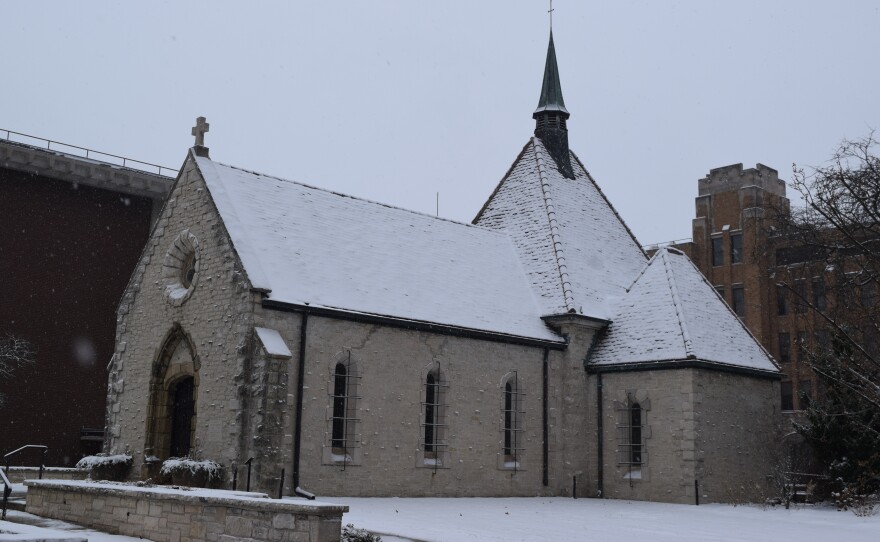
The gothic stone chapel certainly stands out among the campus’ mix of more modern, square buildings. While Marquette has been around since 1881, this building is just a bit older than that.
"It was first built in the city of Lyon about 1420, it was known as St. Martin de Seyssuel, and it was a private family chapel," says Robert Newman, a guide at the St. Joan of Arc Chapel.

So why is a 600-year-old chapel in the middle of a Milwaukee college campus? And what does it have to do with Joan of Arc?
An American looking for a private chapel
It’s kind of a wild ride, so let's start with its first home: Chasse-sur-Rhône southeast of Lyon, France. The chapel served the community there for over 400 years before falling into disrepair.
Although it wasn’t in top shape, it still caught the eye of an American who would bring it back to life in the 1920s.
"Enter a wealthy patroness from the United States, Gertrude Gavin, and her husband Michael Gavin. [They] wanted a chapel on their private Long Island estate, and they were very high in Catholic laity, not only because of philanthropy, but also because of the works they did themselves," notes Newman. "So they arranged with the Archdiocese of Lyon to have the chapel deconstructed — what was left of it —stone by stone, and rebuilt on Oyster Bay, Long Island."
Gertrude Gavin came from railroad money, so that’s the kind of thing you can do with obscene wealth. The chapel was to be built next to a French Renaissance chateau the Gavins also purchased, shipped and reassembled from France.
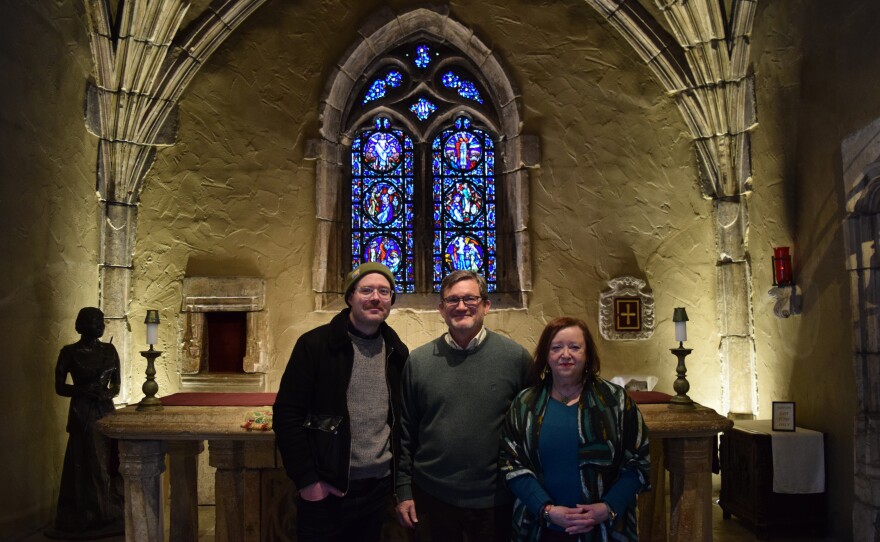
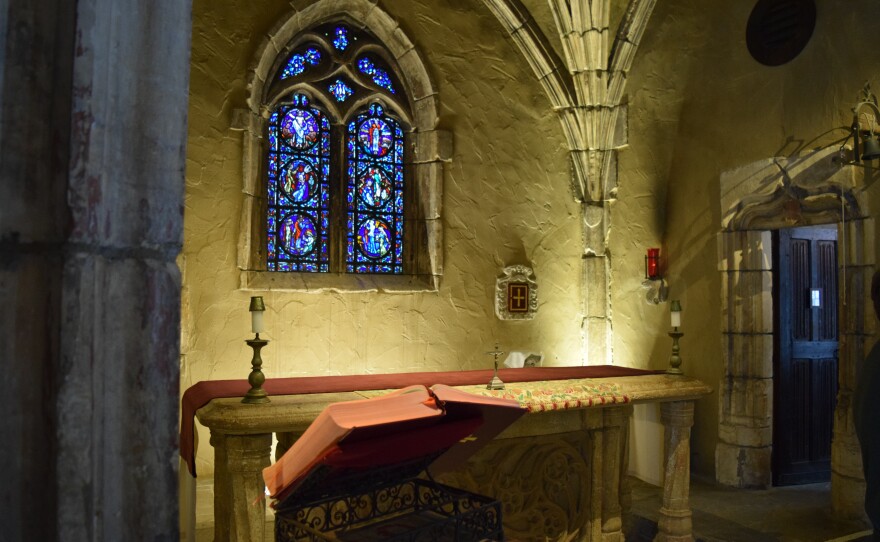
To help honor the chapel’s style when it was rebuilt, Newman says that Gertrude Gavin hired Boston artist Charles Connick, an expert in medieval French-style stained glass, to create the windows for the chapel.

"He agreed to the commission, but he traveled to France for almost a year for two purposes: for inspiration from churches that Joan prayed at, or also from churches she may have prayed at that were around, and to study the art," says Newman. "But he also went to patrimony, exclusive warehouses in France, and purchased glass from medieval French churches so that the color would be authentic and identical to the colors, the blues, the reds, the greens that Joan had seen in the 15th century. Those were incorporated into the chapel in the 1920s, so the claim can be made, 'Joan saw those exact images.'"
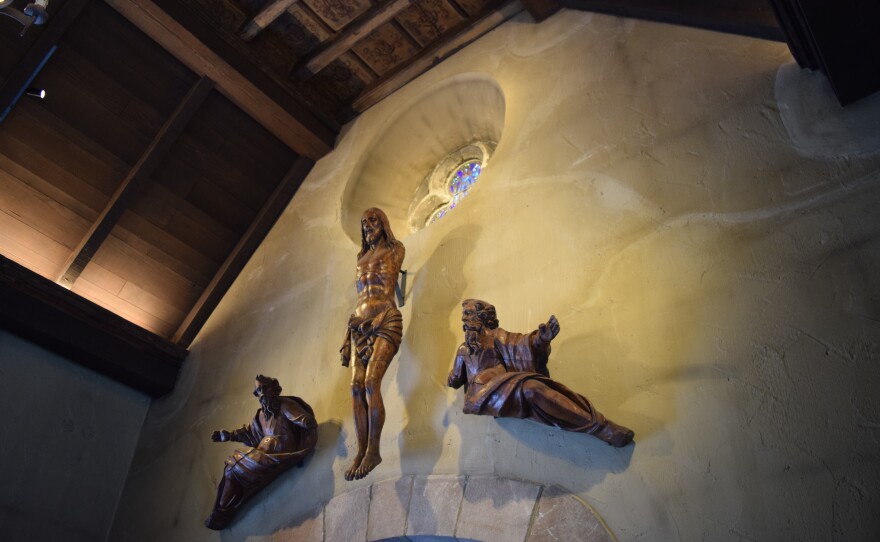
Other objects were added to the chapel when it was reconstructed in Long Island, such as a 13th century altar from Ireland, 15th century wooden beams from France, wooden art pieces, and more to restore it to a functioning place of worship on the Gavins’ private property.
From St. Martin to St. Joan
Now, for the Chapel’s current namesake, St. Joan of Arc. Originally the chapel was named after St. Martin, but around the time Gertrude Gavin was rebuilding it at her home, Joan of Arc was being canonized.

"We should say, when talking about Joan of Arc, there's always the caveat that there's the legend — there's the actual person who did exist — but there are not a lot of public records at the time," notes Dr. Jennifer Vanderheyden, associate professor of French & Francophone Studies at Marquette.
Joan of Arc is the French heroine of the Hundred Years War between England and France in the Middle Ages. She grew up in a small French town that like many others, was ravaged by the English.
"The legend is that she was a peasant girl and keeping the sheep, [but] that probably is not true. Her father did have a function in Domrémy, as far as I think he was a tax collector. So they were of minimal means, but they weren't destitute by any means. And [Joan] was happy there, but she was very religious," says Venderheyden. "She started hearing voices of mainly [St. Michael the Archangel, St. Catherine of Alexandria, and St. Margaret of Antioch], that were telling her through God that she was to lead this mission to save France and to go free the city of Orléans."
Joan led the French army to key victories, securing the coronation of Charles VII. But she was captured by the English, convicted of heresy and burned at the stake. She was only 19.
Vanderhayden says Joan of Arc is an early example of a feminist, though that term didn’t exist during the Middle Ages. She was a woman boldly breaking her society’s rules around gender.
"She was most of all, and foremost, very religious. I mean, it was a divine mission. If she needed to wear men's clothing in battle, it was practical obviously… She was captured and accused of heresy, and the wearing of the men's clothes had a lot to do with that accusation," Venderhayden notes. "[Joan's] mission was divine and patriotic, and that was — the aspect of standing up, being independent. She couldn't read or write, so it's not as if she wrote a manifesto, but her words during the trial are also very clear that she obeyed God."
Joan of Arc was posthumously re-tried and vindicated. She officially became the patron saint of France in 1920.
Gertrude Gavin was so captivated by Joan of Arc that she wanted to rename the medieval chapel (the one she had shipped to her New York home) in Joan’s honor.
"The Gavins, they petitioned the Archbishop of Brooklyn for permission to rename the chapel from St. Martin to St. Joan, and they said you got to do better," Newman says. "That's where the stone comes into play."

The stone is known as the “Joan of Arc Stone.” It was from a Marian Grotto — an outdoor shrine dedicated to the Virgin Mary. Legend has it that Joan stopped to pray there during her travels.
"She finishes her prayers, she kisses the stone, the ground stone that she was laying upon, and then she gets on her horse, slaps her gauntlet and says, 'Go forth boldly.' And they go on to the day," says Newman. "And that stone was acquired from a Marian Grotto that was being demolished or dismantled, I'm unsure, in the 1920s. The bishop from that region contacted the Gavins and said, ‘We think you want to put this stone into your Chapel.’ In other words, incorporate it into the building, because then the claim can be made that Joan prayed here."
The lore of the Joan of Arc stone is that it remains a cooler temperature year-round, no matter the season.
Newman says some Marquette students looked into it back when the chapel was reconstructed on the campus in the 1960s.
"The mechanical engineering students were [supposedly] the first ones to insist on measurement… their findings were that the stone where Joan kissed and wept upon is always about three degrees cooler," he notes.
Newman adds that it has since been measured with more high-tech instruments by Marquette's physics department, and they also confirmed the stone remains a cooler temperature.
How the chapel came to Marquette University

Gertrude Gavin’s estate was purchased by a couple named Mark and Lillian Rotman in 1962. But there was a fire on the property, and everything was lost, except the chapel.
The Rotmans wondered who could benefit from what was left. Turns out, Lillian Rotman had a relationship with the Haggerty Museum of Art at Marquette, and they decided to gift the chapel to the university.
This was the second time the chapel was meticulously deconstructed stone by stone, catalogued and moved to a new home. It took workers nine months to carefully take it apart before it was rebuilt on Marquette’s campus.
As it was reassembled, some changes were made to add modern conveniences like heat and electricity. It’s a mix of ancient and not so ancient.
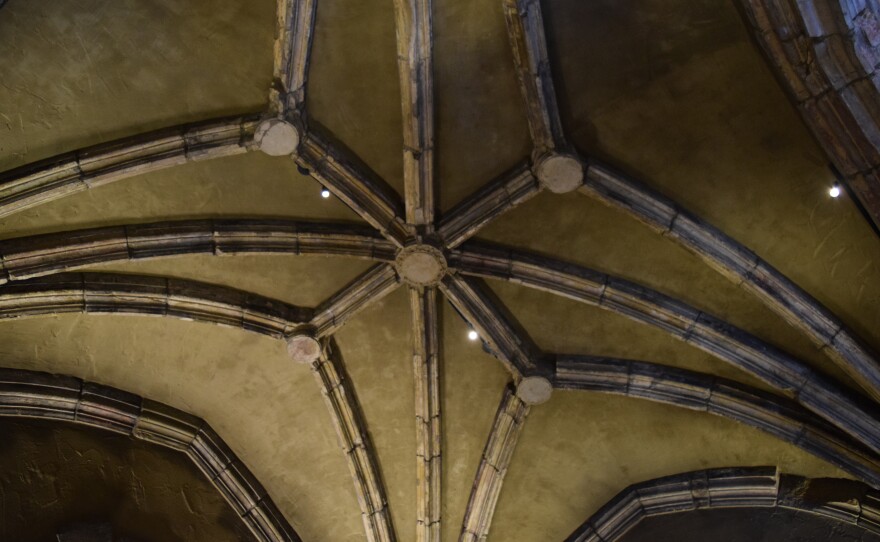
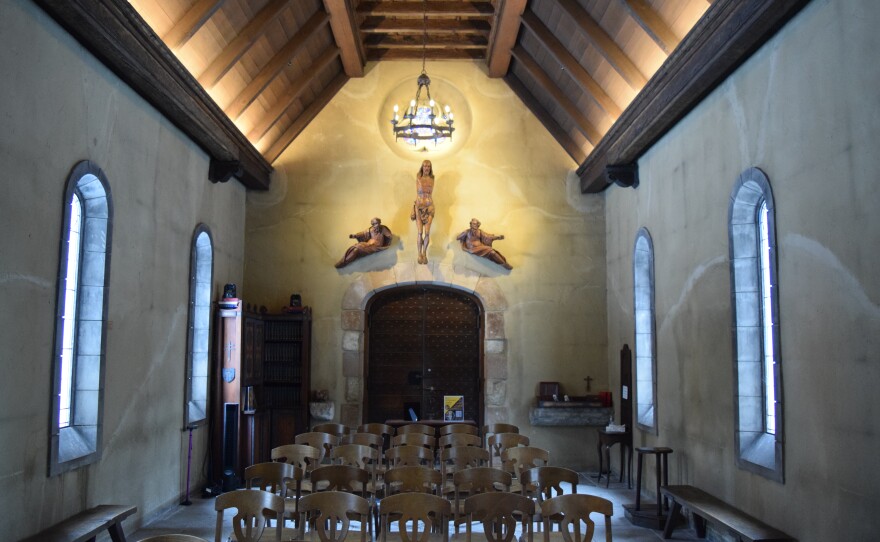
"The nave was elongated when it was first built here in 1966 and again elongated in 2018. So the farther you get away from the main altar area, it becomes more of Wisconsin," says Newman. "So the stone on the outside of the building is Lannon stone from Menomonee Falls, the doors is more modern hardware, but the original hardware and the original woodwork is from France. The bench is from 1640s from Normandy France...The altar is a 13th century altar from Ireland, the woodwork on the ceiling is a blending of beams from France from the 15th century and beams from Douglas fir from northern Wisconsin. From where you sit, you can see these beautiful Gothic arches — that's all original stone."



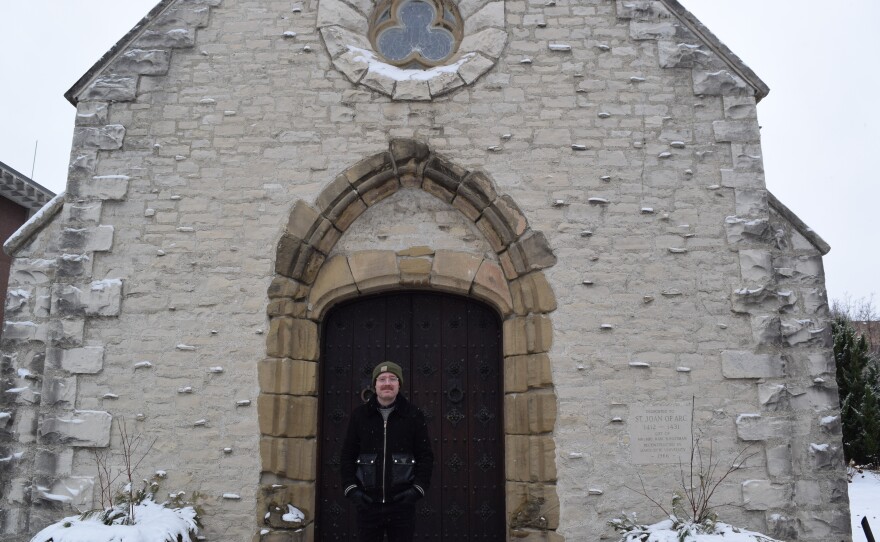
"The farther you get away from the main altar area, it becomes more of Wisconsin."Robert Newman, St. Joan of Arc Chapel guide
The first shipment of the twice disassembled chapel arrived in Milwaukee on January 31, 1965, and the chapel officially opened in 1966. Since then, it has served as the heart of the Marquette campus and community.


French professor Dr. Venderheyden explains what it means to her:
"I developed an entire course on Joan of Arc and it was really interesting to see how much the students love the chapel, they love to come to mass. But a lot of the history they don't really study normally, and… we always we had the first class here for the for the course, and it's very nice because you don't have all the technical additions. And so we can just sit here and read a text and talk about Joan of Arc."
And chapel guide Newman shares what Father Fred Zagone, the university advancement chaplain, says about the chapel: "It's the heart of the Marquette campus, and it's also the oldest building in the Western Hemisphere still being used for its designed purpose. Sounds like a Jeopardy question, but that's the chapel."
There are Catholic masses at the St. Joan of Arc Chapel every day during the school year and visitors are welcome during or outside of mass.
Eric Shoen, who submitted the Bubbler Talk question, shares what stood out to him: “Finding out that this is the oldest still functioning structure in the Western Hemisphere is amazing. There is definitely a reverence here that’s going on that you can feel.”
_


