


The ARTservancy is a year-long artist residency that blends art with conservation.
The program is a partnership between Gallery 224 in Port Washington and nature preserves throughout Southeast Wisconsin. Twelve artists choose a preserve to spend time in throughout the year and create artwork that represents what they discover. Each residency project is then exhibited at the gallery the following year, rotating monthly.
Rebecca Jabs is one of the artists-in-residence and is exploring the Forest Beach Migratory Preserve for her project. She’s also a science illustrator in Manitowoc, Wisconsin.
Jabs spoke with Lake Effect’s Xcaret Nunez for this month’s Chirp Chat about the history of Forest Beach and why bird migration inspires her ARTservancy project.
You can follow Jabs’ artwork on her website and see her ARTservancy exhibit at Gallery 224 in 2027.
This interview has been edited for length and clarity.
Xcaret Nuñez: Why did you choose the Forest Beach Migratory Preserve as the place to study for your ARTservancy project?
Rebecca Jabs: I chose Forest Beach for several reasons, one being proximity to where I live [in Manitowoc]. But more importantly, the name – ‘Migratory Preserve’ – piqued my interest as a birder. Learning how the management of this particular preserve serves as a migratory bird stopover habitat was really intriguing to me. So that's how I ended up selecting Forest Beach, which is managed by the land trust called Restoring Lands. This location also has a very interesting history. You might've noticed that as you drove in, its address is on Country Club Road. That's because this land was once a golf course, and when it was no longer used as a golf course, management was taken over by Restoring Lands, and restored and managed primarily as migratory stopover habitat for birds. We know that birds migrate; they have breeding grounds often in the North, and then they winter in locations to the South. But what we sometimes don't think about as much is what happens on that journey. When they are migrating, mostly during the night, they need to make stops for food and maybe rest, and a little shelter. Locations like Forest Beach provide that critical stopover habitat that helps birds on their journey.
![Jabs’ ARTservancy project [current work in progress pictured above] is inspired by the birds migrating through Forest Beach.](https://npr.brightspotcdn.com/dims4/default/43c179b/2147483647/strip/true/crop/2686x3582+0+0/resize/840x1120!/format/webp/quality/90/?url=http%3A%2F%2Fnpr-brightspot.s3.amazonaws.com%2F7a%2F0d%2F2f96decb458b9ce8a82f330be91f%2Frebecca-jabs-3.jpeg)
Walk me through your creative process: What do you take notes of when you’re walking through Forest Beach?
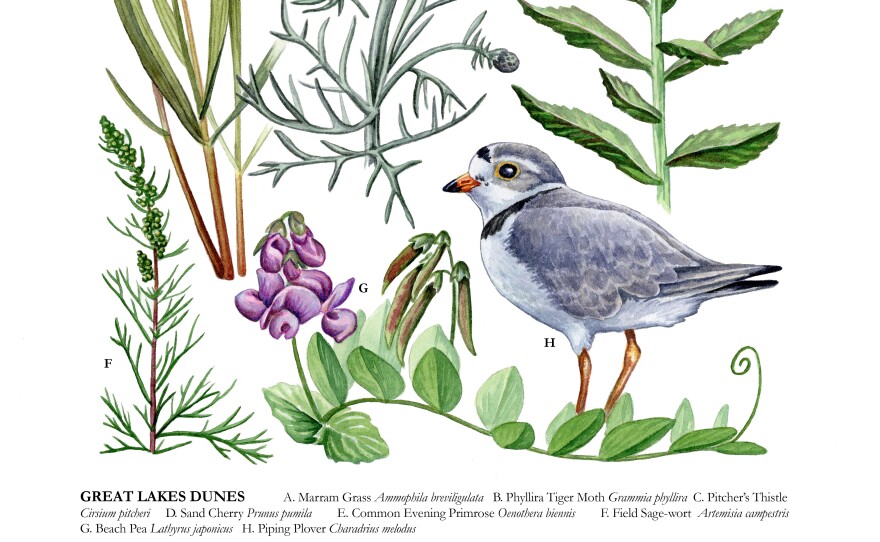
We are uniquely situated here in Wisconsin along the Mississippi Flyway, which is a route that birds use during migration. So when I come [to Forest Beach Migratory Preserve], I’m primarily looking for birds, and I use the app called eBird. So I am birding both with my binoculars and by ear. You don't always have the chance to see a bird, and hearing it creates a wonderfully immersive experience as I'm walking. It puts me in the moment as I am walking through the preserve, thinking about birds. But more than that, I find my thoughts meandering to the history of the land and the value of land and different ways we ascribe value to land. These are all things that contribute to my experience here as I think about how I would interpret Forest Beach Migratory Preserve in the form of my art. When I get home, I compile my checklists, and I've been thinking about ways to represent the data I've collected in a way that communicates more than data. So that's my next challenge. I have been focusing on migration as a topic, so I've been sketching the birds in flight – which is a time-consuming activity, but it's really a labor of love. Now what I'm doing is thinking about how to complete this project and represent a timeline of migration that gets people to think about how much is happening in our world and in the natural community if we take the time to look.
What forms of media will you be using to create your ARTservancy project?
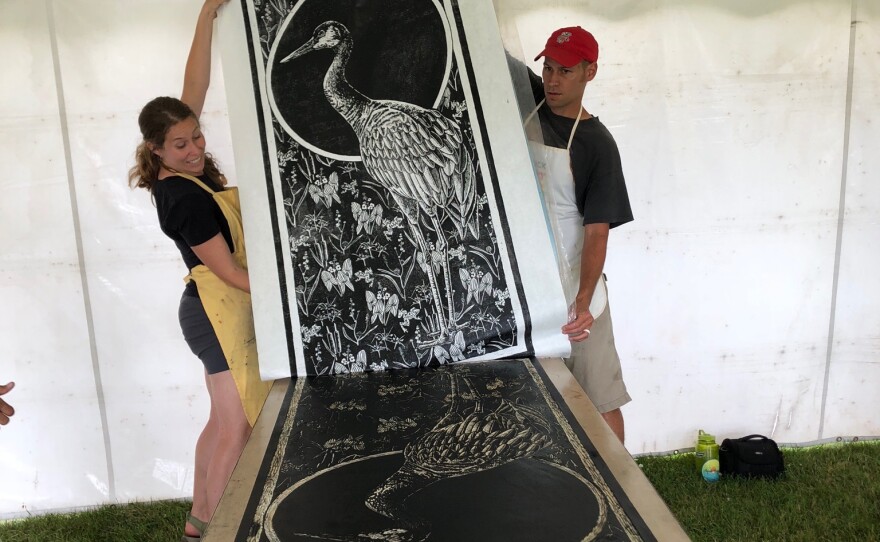
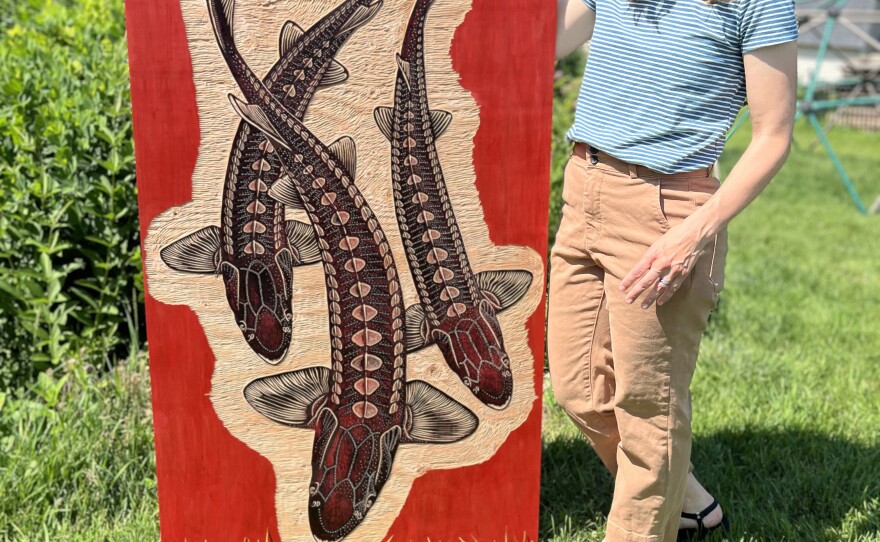
My project is still very much in the works because, with any large-scale project, there are different logistical factors to figure out: Can I do this? And if so, how can I make this? So I am in the process of drawing about 75 different bird species in flight. My list at this moment in time stands at 118 species observed [at Forest Beach Migratory Preserve]. But some of those are resident birds that stay here year-round. Some are just really big, and I want to represent all of the birds at life size. So I'm focusing on migratory songbirds in my project. What I'd like to do is find a way to combine drawing, painting and printmaking techniques to represent the movement of birds on a large scale, at a large scale.


What do you hope people take away from seeing your project?
Well, on the surface level it's about the birds. If you take the time to look, you're going to be rewarded. But on a deeper level, I'd like people to think about the land, how we use it and how we see our relationship to the land. And what does this mean for the actions we take, and how do we manage the land around us? I see myself as part of the natural world instead of being separate from it. I appreciate the mindfulness I experience when I'm out on the trail with my binoculars. I'm in the moment and… I feel like I'm being let in on this secret, and it's a gift that I get to observe the things I do.
Chirp Chat’s Bird of the Month for August 2026

Black-billed Cuckoo
“The Black-billed Cuckoo is one of those birds that’s a relatively common breeding bird here in Wisconsin, but I think a lot of people don't realize it's here,” Jabs says. “I know I sure didn't, just because they are very secretive and shy, and they don't tend to behave like other birds. They have a habit of sitting very still in a tree. So I always get the sense when I see one that it’s allowed me to see it. That makes the sighting very special.”


