

On Nov. 10, you may have seen a big cloud of smoke at the eastern edge of downtown Milwaukee.
It was a prescribed burn on about eight acres of Lakeshore State Park.
Park managers hope the burns will become a routine tool to help deep-rooted native plants there.
The park is a 22-acre oasis along Lake Michigan, just south of Discovery World and east of the Summerfest grounds.
People enjoy hiking, jogging and biking and ice fishing here. But on the morning of Nov. 10, park manager Elaine Zautke has to shoo them away.
The park has to be visitor-free when five highly trained crew members arrive to set fire to its prairies. Wearing helmets, protective gear and face coverings, they’d soon get to work on the prescribed burn.
They watch closely, tamping down the edges to make sure the fire stays where it’s intended to be.
Zautke says Lakeshore’s design makes the job easier.
“We have designated prairies that are surrounded by sidewalks," she says. "Essentially, our sidewalks will work as burn-breaks. If it was one big field, they would mow lines through the field to be able to control it and burn in sections. At Lakeshore, we kind of already have those sections mapped out, and they're really small. So typically they will burn to one or two of our designated prairies at a time, making the process a pretty quick one."
Wind plays a big role: “Too much wind is kind of a safety hazard. In the past we had concerns about smoke flying onto the freeway system, and so it's actually a little better for this location if it's calm,” Zautke says.
On Nov. 10, a light wind blew due east. “So that's really good that those are the conditions we have today,” Zautke says.
She watches as the crew sets to work, starting at the park’s southeast edge. Working in teams, they dispense fuel from canisters onto the plants, carefully ignite and watch the flames rise and move across the land.
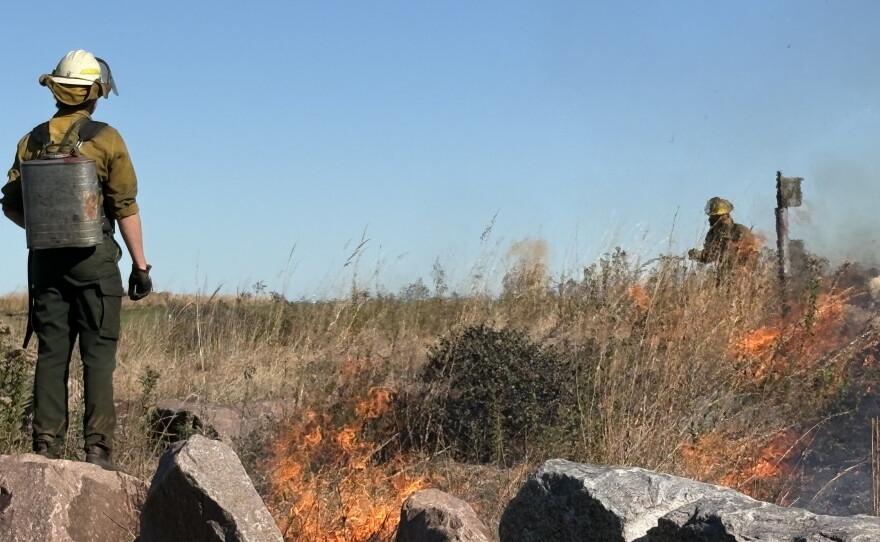
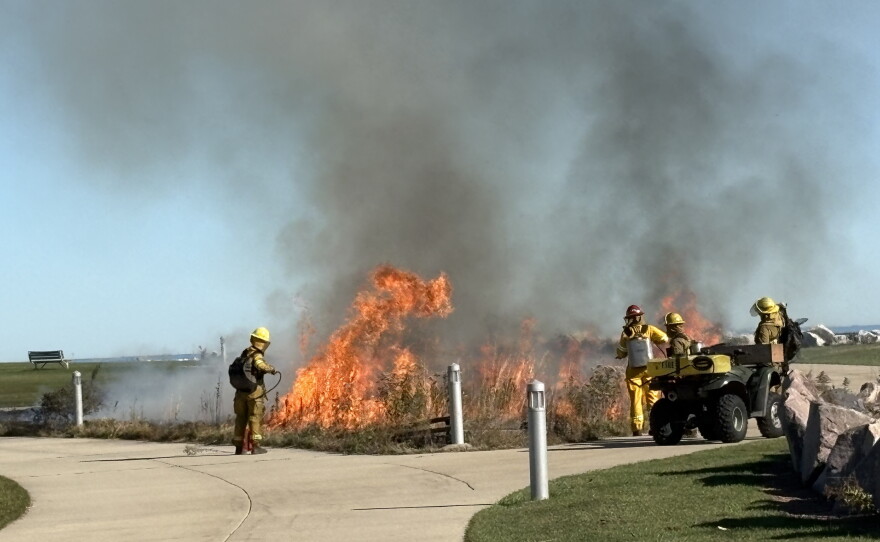
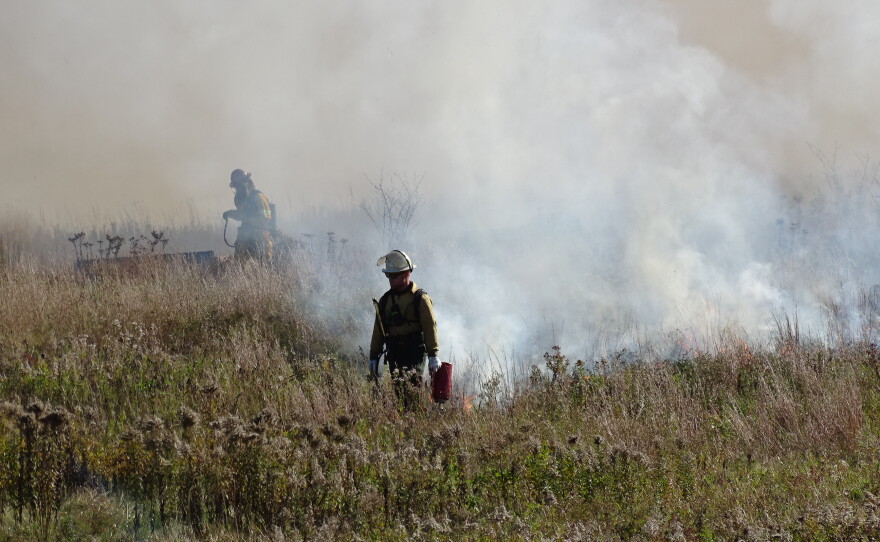
“It is a natural process, naturally occurring by lightning strikes or things like that that would happen out in the open,” Zautke says.
The goal is to reduce invasive plants. Their shallow roots are susceptible to fire, while native plants, which are deep-rooted, “They are able to go dormant and be preserved while the fire burns off the top layer of the soil and the top layer of plant matter,” Zautke says.
Just a few months ago, volunteers added 2,000 plants much-loved by monarch butterflies and other fluttering creatures to Lakeshore’s landscape.

Zautke says even those should do just fine with this infusion of fire. “The fire will not harm them. Those are all natives anyway. Fire is good for native plants so that will be burned as well,” she says.
Zautke says the natives will benefit from carbon, produced by the fire, which sinks into and enriches the soil.
She says Indigenous people long recognized that fire is good for prairies, the rest of us are just catching up.
Still, there are obstacles – including financial. Lakeshore State Park opened in 2007. Its first-ever burn was in the spring of 2025.
“We've slowly been increasing our native spaces since then, but we were never able to do a burn. We did not have the funds,” Zautke says.
A Natural Resources Foundation of Wisconsin grant made last year’s burn possible. This time around, the Friends of Lakeshore State Park secured funding from the Woman’s Club of Wisconsin.
Zautke hopes these two will mark the beginning of more frequent prescribed burns, “Burns should happen every two or three years,” she says. “The last one was a spring burn and this one is a fall burn. So we're trying to see what maybe is the most effective for the types of invasives that we're trying to eradicate here."
Zautke says biodiversity has already improved.
“Maybe not as much on the eliminating invasive side of things, but at least we got more native plants, more space for those plants to populate,” she says.
Zautke and her small park team look on as smoke fills the sky and considered what next spring will reveal.


