This story was originally published May 11, 2026.
Damaging winds tore through the Milwaukee region Aug. 18, taking down trees in their path.
After storms in late April, City of Milwaukee crews were doing their final sweep after more than 200 trees either were toppled or were so severely damaged they had to be removed.
We caught up with Milwaukee forestry service manager Erin Stoekl as she watched her crew tend to a tree on South 19th Street.
“Those heavy winds took down a lot of trees or split them out, like this one. There’s no recovering from that,” Stoekl says.
The city’s 90 arborists had already removed 150 fallen trees. Some heaved sidewalks out of the earth along with them. Stoekl says even healthy trees couldn’t withstand the combined force of severe winds and heavy rain.
“The trees can’t handle the winds on top of the soaked, saturated soils,” she says.

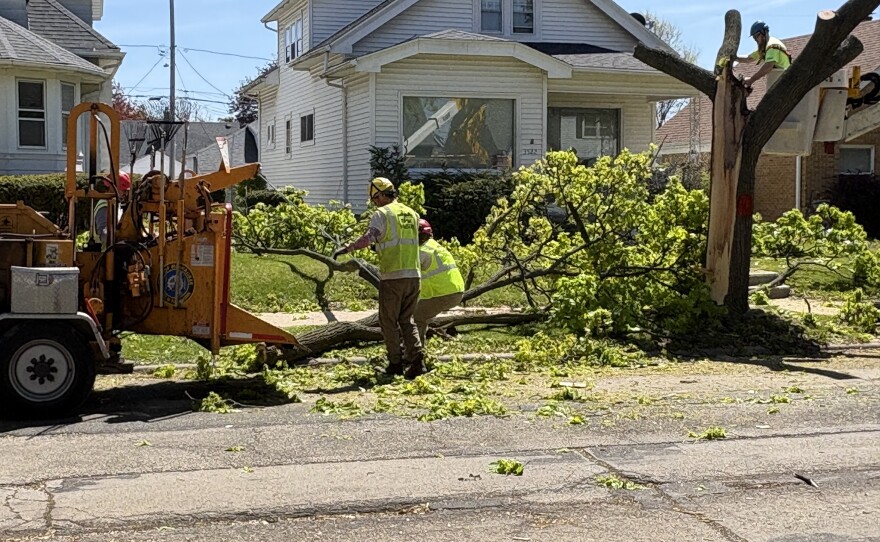
Stoekl’s crews have now moved on to trees like this terminally damaged 40-plus-year-old Norway maple.
“We started by cleaning up the downed half of the tree just to clear the street. I think it was on a vehicle when it first fell," she says. "The arborist in the bucket truck right now is slowly piecing out the tree so the ground crew can handle it, chipping it one section at a time. He’s considering where each branch will fall – wanting to do it in a way that’s methodical and safe for him and for the people on the ground."
Stoekl says if a tree on city land damages your property, you can file a claim.
“Our staff leaves information with owners on how to file a claim. Then there’s a hearing with our judicial and legislative committee when they review what happened. The committee rules on whether the city was negligent,” Stoekl says.

Negligent in this case would mean the tree wasn’t healthy or cared for properly by the forestry folks. In her dozen-year urban forestry career, Stokel says, “I’ve never seen damages awarded,” because, she says, Milwaukee cares for its trees.
“All trees are inspected at least once every five years," Stoekl says. "Any hazards or major clearance issues are addressed when we’re there, as well as a little bit of structural pruning for younger trees. And structural pruning is where it’s at in terms of helping with longevity. So the more we can prune trees when they’re younger, the more resilient they’ll be in the face of storms. That comes more into play more for an average storm. I don’t think it would have helped very much for [late April], but on average, having a healthy pruning program does help prevent major storm failures."
The trees that succumbed to the April winds will be replaced. City arborists plant about 3,600 young trees every year.
“We’re just finishing our spring planting season, so very earliest they’ll be replaced is this fall, but more likely some time in ’27,” Stoekl says.
That’s what’s being done to protect trees on city property. But you might be wondering about the trees in your own yard.
August Hoppe is a commercial arborist and member of the Wisconsin Arborist Association.
He understands when people hesitate to keep existing trees or plant new ones.
“They don’t want a big tree that’s going to fall on their house. So, we’ve gotta think about the right tree in the right place,” Hoppe says.
For large established trees, Hoppe says installing cables can help.
“You want the cable placed at the proper height in the tree, and that’s generally two-thirds of the height into the tree,” he says.
Or, strategically trimming limbs to reduce “the wind sail effect" can help.
“The taller the tree is, the wider it is, the wider the leaves are, it essentialy acts as a sail," Hoppe says. "So, if we can prune back part of the limbs — either a little bit of the top, and do like a crown reduction or if you have big long side limbs, if you reduce that sail effect."
Hoppe urges people to call an arborist. “Develop a good relationship with an arborist that you can trust, that’s going to give you good advice, preferably a certified arborist, and they can provide a lot of peace of mind. And if your tree really is a hazard, they’re gonna tell you that and they’re going to figure out ways to mitigate that for you."
Hoppe and the arborist association are trying to spread the word about taking care of our canopy.

They spent a recent Saturday helping kids climb a giant maple tree in Port Washington.
“These big trees provide so much more value to our landscape, more shade, more oxygen, more carbon sequestering, absorbing water — all those different things,” Hoppe says.
He figures if kids grow to love trees, their parents will too.
_