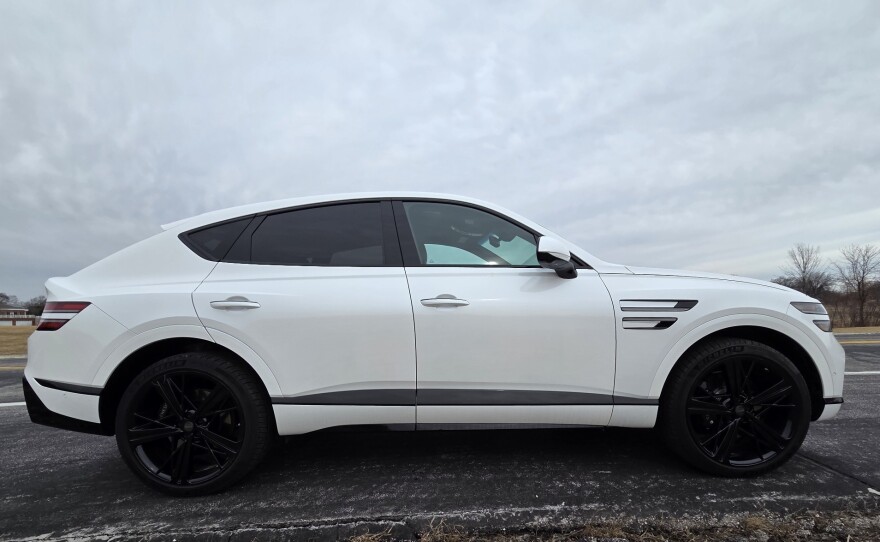
For those of us who grew up in the age of sedans, cars if you will, it’s a little tough to accept a fastback SUV being called a coupe.
That used to signify a two-door car, a sportier version of a family sedan. Often that meant more horsepower, and a fastback tail.
But BMW and Mercedes-Benz have co-opted the coupe label for a couple of its SUV fastbacks the last couple years and now Genesis joins the luxury SUV coupe brigade with its (wait for it) GV80 Coupe 3.5T E-SC MHEV Prestige Black AWD.



Quick explanation of all those abbreviations. The 3.5T is the easiest, standing for a 3.5-liter twin-turbo V6 and the E-SC insinuating to power is being augmented by an electric supercharger. MHEV is short for a mild hybrid electric vehicle. Suspect you already know what AWD is.
The GV80 Coupe is a spinoff of Genesis’s near perfect 3-row

It rides on the same platform with the same engine, but without row three seating and with a decidedly swoopy fastback profile that does insinuate coupe and athleticism vs. the SUV’s family hauling comfort.
Oh, there’s plenty of comfort inside, but let’s stick with the power and sporty nature of this Coupe.
That twin-turbo and supercharged engine with a mild hybrid assist pumps out a hefty 409 horsepower with 405 pound-feet of torque. The stopwatch happy folks at Car and Driver say it’ll zip from 0 to 60 mph in 5.2 seconds, darned quick for an SUV weighing north of 5,100 pounds.
As with its family-friendly cousin, the GV80 SUV, that power is delivered smoothly and with little drama. That is unless you dial in the Sport or Sport+ drive modes, 2 of 5. Those launch the Coupe with terrific power and firm up the steering and ride to feel like a racer. Is that needed? Probably not, but if sporty is what you seek, both modes will satisfy.
Likewise, the AWD keeps the four wheels firmly planted for maximum traction and the 8-speed automatic is perfectly mated to the sophisticated V6.
That mild hybrid system, as with others, is aimed at providing smooth startup, stop/start action, and low-speed propulsion aimed at coddling passengers and ever so slightly helping gas mileage. More on that in a sec.
In Eco or Comfort drive modes the handling is moderately heavy as with other luxury SUVs, but easy to control on the highway and when parking. Ride, well, here’s where you’d better be prepared for a sportier feel all the time. It’s much firmer than the 3-row GV80, adding to its sporty vibe, but can become a bit annoying on crumbling city streets, considering the Coupe’s price tag.
Let’s get that out of the way, shall we?
The base GV80 Coupe lists at $83,345 including delivery, while this top-level Prestige Black starts at $90,985. There’s one trim between those figures, an $89,145 trim known as 3.5T E-SC MHEV, no Prestige or Black goodies.
If you haven’t already grabbed your Nitro tablets, consider that a Porsche Cayenne starts about where the Genesis stops for pricing and last year’s tested BMW XM Label, a sporty plug-in hybrid SUV, listed at $191k, perhaps something the 1% crowd can appreciate.
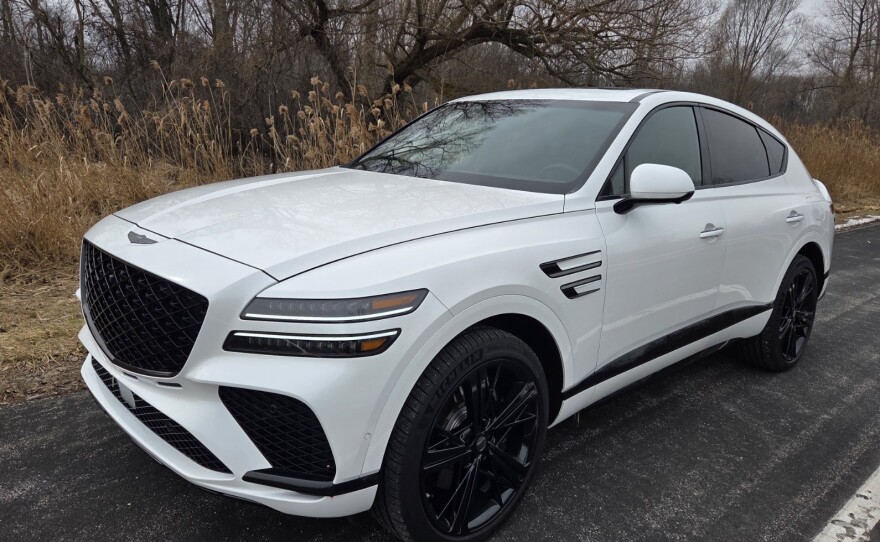
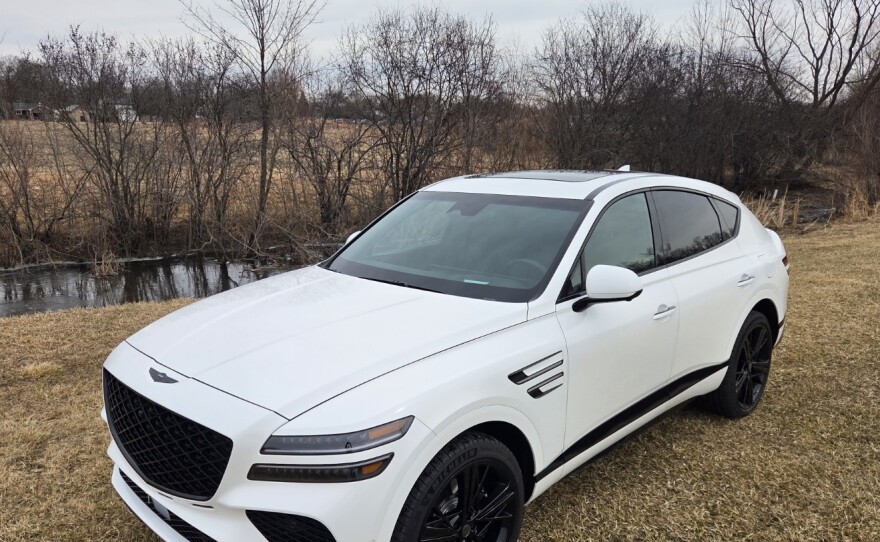
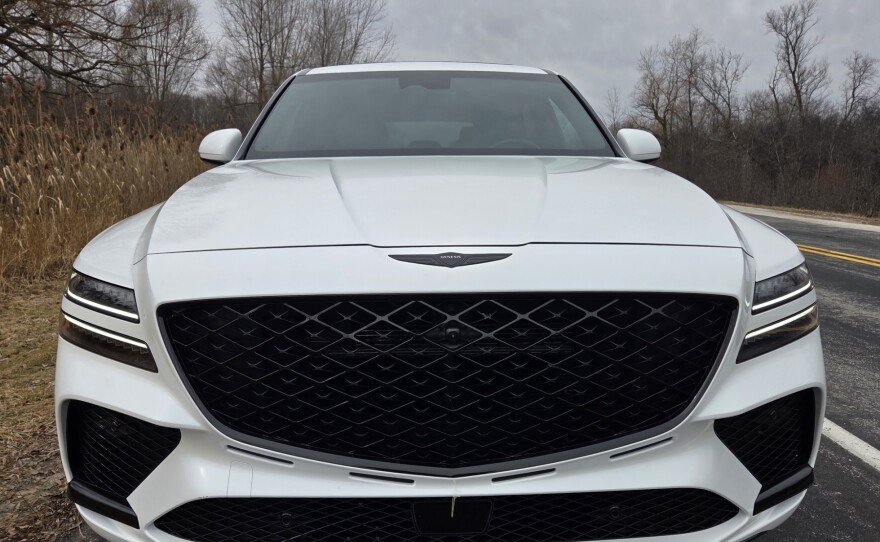
While not an immediate fan of fastback SUVs I must say this Genesis is a sharp-looker, but I’m a sucker for Genesis’s consistent twin-bar head and taillight styling and handsome grille. Plus, this model looks sleeker than previous SUV Coupes, with a less bulbous backend.
The tester’s bright sparkling Uyuni white paint scheme was handsome too, and only added $650 to the sticker, putting it at $91,545. For those watching their budgets, just know some luxury makes charge up to $6,000 (As Dave Barry would say, I’m not making this up.) for a special color.
Know too that the Prestige Black edition blacks out (naturally) some of its trim. Many makes now emphasize dark versions of their large SUVs.
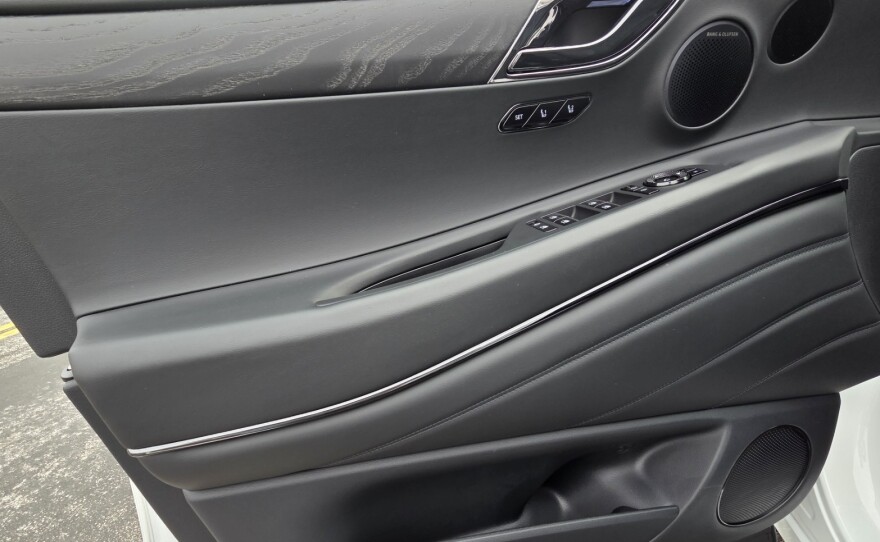
Genesis provides black brake calipers and grille along with headlight bezels, and bumpers. While inside the audio speaker grilles are black as is the switchgear and trim is black ash wood.
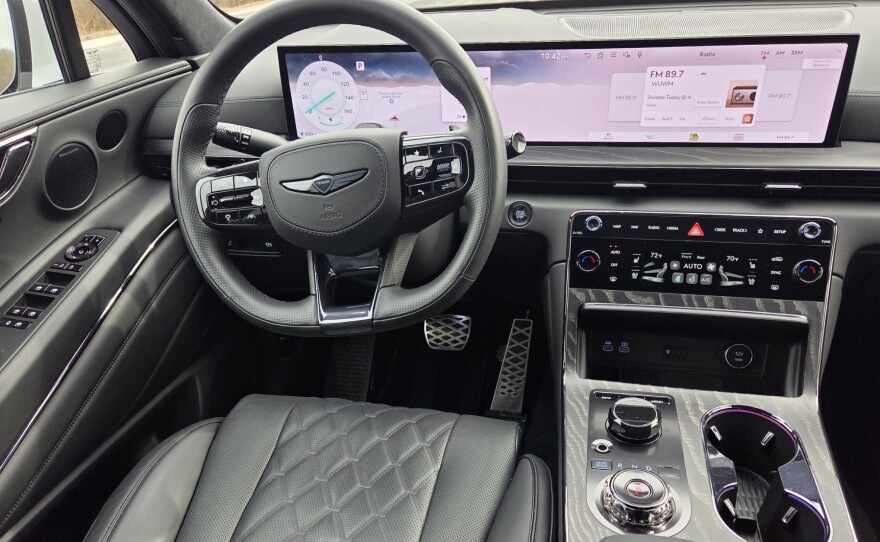
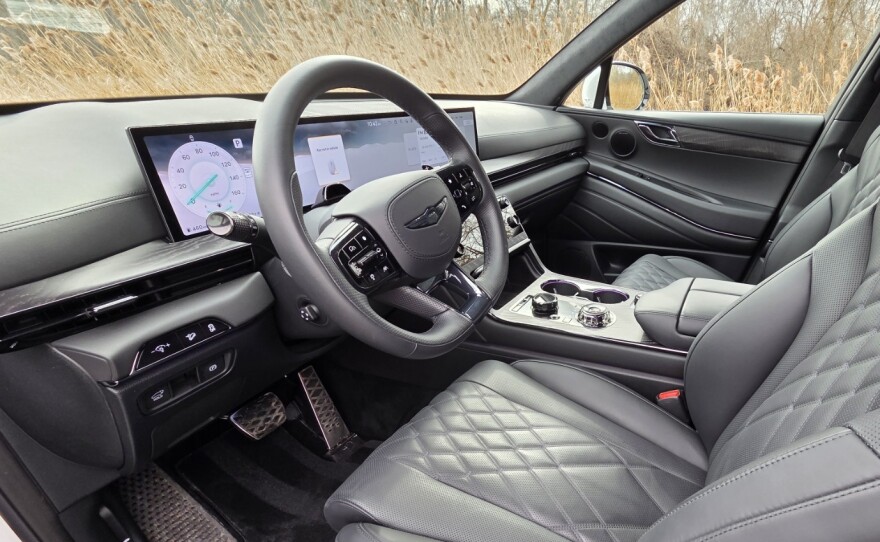
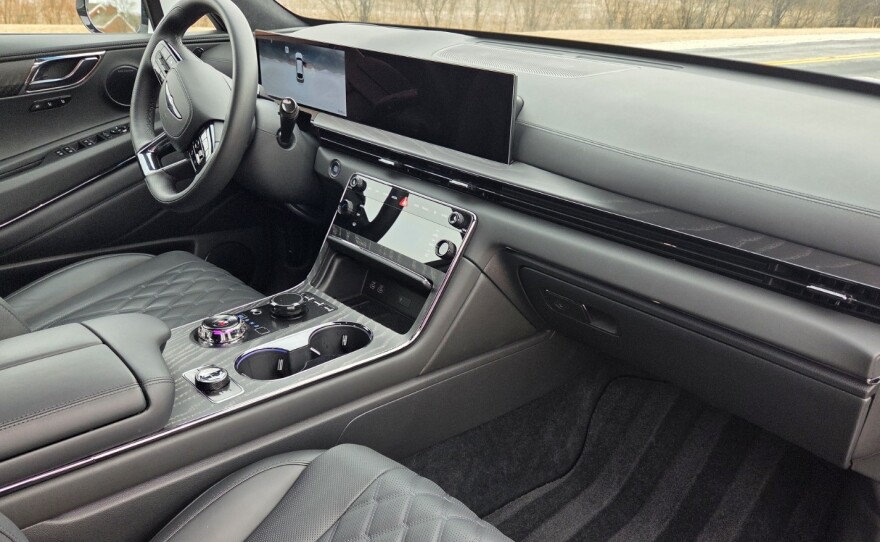
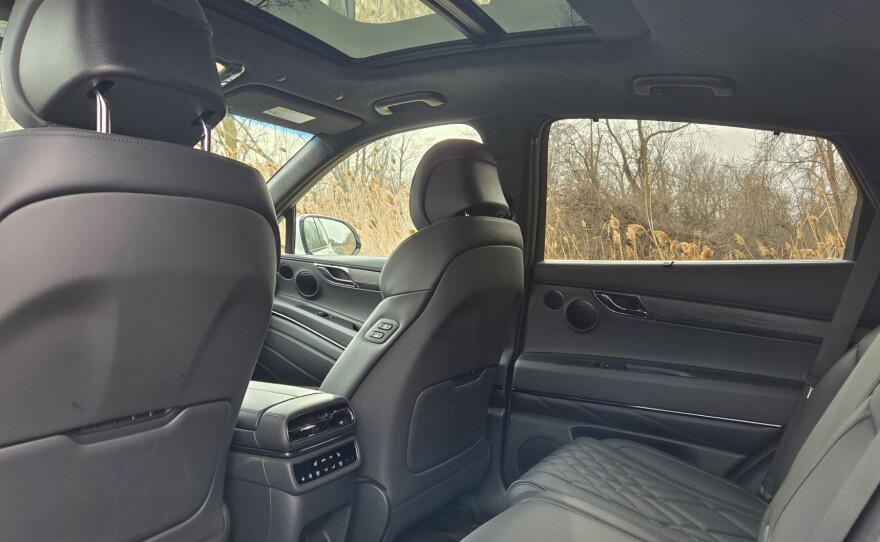
But blacked out or not, the interior makes the Coupe feel and look special. The tester featured black quilted leather seats and soft quilted door inserts along with smoked chrome trim on dash, doors and console. That black ash trim is there too, including the console’s top.
Overhead is a suede headliner, two-pane panoramic sunroof and multi-color accent lighting, purple during my test drive.
The steering wheel is a leather-wrapped flat-bottom number with a power tilt/telescoping feature.
Seats are extremely comfy and supporting while offering beaucoup power adjustments. On top of that they are ergo-motion, meaning they adjust to the drive mode settings. So, in Eco or Comfort the side bolsters and seat bottom relax a bit, while they firm considerably for Sport and Sport+ modes.
Seats are heated and cooled up front and in row two, although on the press fleet tester the front passenger’s seat did not seem to heat or cool. Probably an errant fuse.
Did I mention the interior is boardroom quiet? Active noise control is at work.
Dash layout is crisply styled and executed with a 27-inch combo dual screen for driver and info screen functions, the info being a touchscreen. Oddly Genesis continues with a big dial on the console that is a backup adjustment for the info screen. Sadly, it is the same size as the console’s round shifter knob, so easy to mix those two up when the driver is hurried. Making the info knob much smaller would help.
While whining, there’s also no rear window wiper, something that should be mandatory in our climate. Additionally, the haptic climate controls did not react when tapped by a gloved hand. These need to be more sensitive, or engaged via physical buttons or toggles.
This trim does include a premium Bowers & Wilkins audio system, a fine upgrade, along with a wireless phone charger, navigation system and wireless Android Auto and Apple Car Play. Soft-close doors that latch themselves are another perk.
Safety equipment? All the usuals are here, from lane-keep assist and forward collision avoidance, to the same for blind spots and parking sensors. There’s even safe exit tech so one doesn’t open a door into passing traffic.
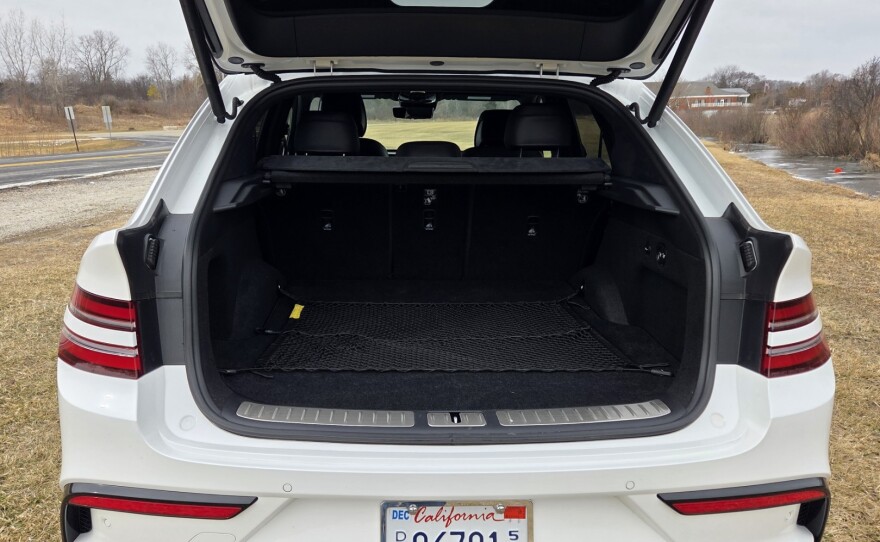
With no third-row seats there’s oodles of storage behind row two at 30 cubic feet and 61.1 cubic feet if row two seats are powered down. One can do that from the second row or via buttons in the cargo area. Note that is a bit less cargo capacity than in the 3-row GV80 SUV, as the fastback roof and couple inches trimmed off the rear slim the cargo area some.
Despite the mild hybrid system, the GV80 Coupe still isn’t an MPG champ. It’s rated at 17 mpg city and 22 highway by the EPA. I got just 19 mpg and had managed 19.2 mpg in the three-row model last year.
Note this Genesis is still made in South Korea, so tariffs apply.
As for competition, the 3-row GV80 may be the Coupe’s strongest competitor as it too is awfully good looking and runs $75k to $81 grand for the V6-powered models. Drop down to the GV80 with 2.5-liter turbo I4 with 300 horsepower and a base model dips to $60k.
Others to consider would be the BMW X5 or X6 or the Mercedes GLC 43 Coupe.
FAST STATS: 2026 Genesis GV80 Coupe 3.5T E-SH MHEV Prestige Black AWD
Hits: Sharp looker with stellar interior. Excellent power, fairly sporty handling and AWD. Super quiet interior, with well-shaped heated/cooled front and rear seats, heated wheel, panoramic sunroof, wireless charger, B&O premium stereo, full load of safety equipment, large dual screens and flat-bottom power tilt/telescope steering wheel.
Misses: Firm ride, round shifter dial same shape as info screen adjustment dial, so confusing, haptic climate controls, no rear window wiper. Passenger seat heater didn’t function.
Made in: Ulsan, So. Korea
Engine: 3.5-liter twin-turbo V6 w/48V e-Supercharger, 409 hp/405 torque
Transmission: 8-speed automatic
Weight: 5,132 lbs.
Wheelbase: 116.3 in.
Length: 195.5 in.
Cargo: 30-61.1 cu.ft.
Tow: 6,000 lbs.
MPG: 17/22
MPG: 19 (tested)
Base Price: $90,895 (includes delivery)
Invoice: $86,425
Option:
Uyuni white paint, $650
Test vehicle: $91,545
Sources: Genesis, www.kbb.com