If you thought Mazda redesigning its top-selling CX-5 compact SUV would make distinguishing it from its nearly as popular CX-50 any easier, you were mistaken.
The new for 2026 CX-5 now rides on the same 110.8-inch platform as the CX-50. That means both wheelbase and body length are 4 inches longer than the previous model. The result is the CX-5 is still 1.2 inches shorter than the CX-50, an inch narrower, but about 3 inches taller. Yet it has more cargo space and its expansion gives it two more inches of rear seat legroom. Fine!
Let’s focus on the CX-5, then explain what else the CX-50 offers in comparison.


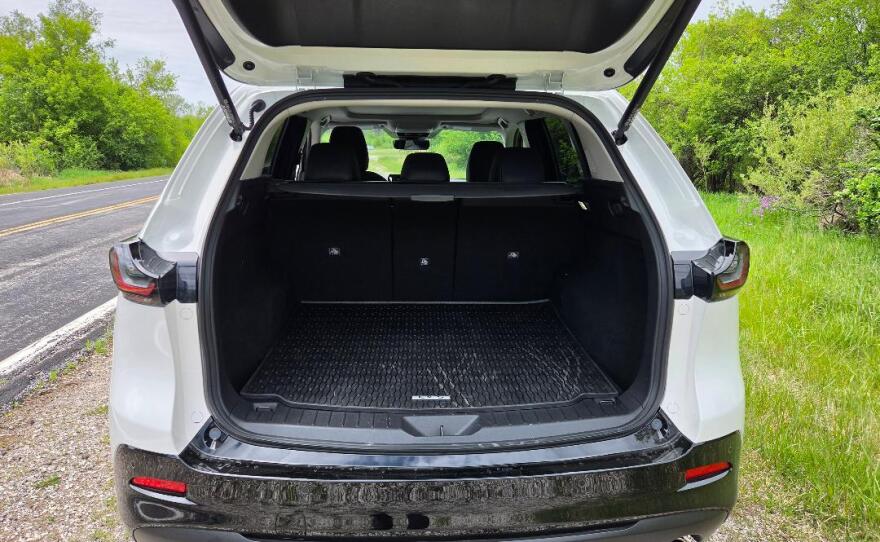
The redesign really focuses on improving the occupant’s comfort and ease of access, plus ditching the ever-annoying console-mounted screen tuner. Hallelujah!
The new CX-5’s rear doors open wider now for easier rear seat access and that two inches of additional legroom was welcome by four of us who made the roundtrip to Indianapolis for the Indy 500 recently.

Mazda has bumped up the info screen size to a whopping 15.6 inches, plus it’s a touchscreen negating the need for that silly console tuning knob. The downside is that the touchscreen was, well, touchy. Both front seat passengers tried repeatedly to punch in a new radio station but often nothing took. Then if we held the station button too long it substituted in the one we were listening too on the “Favorites” menu. Argh!
Still, the bigger touchscreen is an improvement, even though Mazda also insisted on putting all climate controls and the heated/cooled front seats and heated steering wheel haptics there. Tiny and hard to find on the screen while driving.
Many brands have again started taking the climate and seat buttons out of the screens and replacing with real buttons or knobs. Maybe next redesign, or the next update on CX-50’s interior, as that shouldn’t be far off.
Seats seem to have been reshaped some too so a bit more supportive and less firm, making for better long-distance driving. Rear seats also were comfy, they also are heated in the tested top-trim Premium Plus.

Rear cargo room has grown to near 34 cubic feet, up three, so lugging along luggage is a bit less crowded and the cargo floor has been lowered a smidge for easier loading. The hatch is powered, naturally.
The bright Rhodium White Metallic ($595 extra) tester featured black perforated leather seating and leather trimmed interior with soft door panel inserts. Much of the leather included gray contrast stitching for a sophisticated look while door and dash tops were textured hard plastic.
Dash facing was black leather with smoked chrome trim on the air vent tops along with a tad on the doors. The console was matte black and overhead was a cream-colored headliner along with a panoramic sunroof with creamy shade.

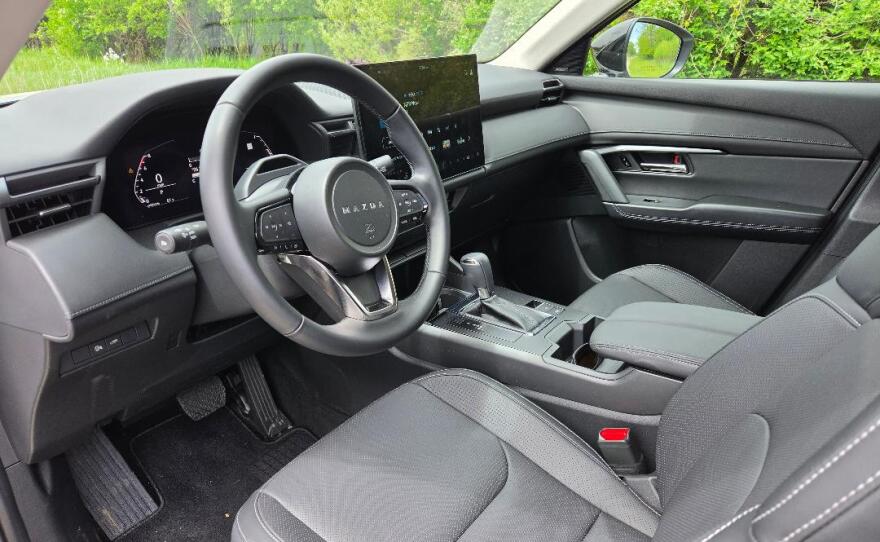
Inside, the power hatch are manual release levers to lower the rear seatbacks to expand cargo space to a generous 66 cubic feet.
Other pluses here include a 360-degree camera, Bose stereo, wireless charger, and an excellent safety system including smart cruise control and a feature that sort of helps with lane changing. With the turn signal deployed it recognizes and helps guide the Mazda between the next lanes’ lines. I see no need for this, but some might like it. It also announced on the dash that the system was unavailable occasionally when I tried using it on the interstate.
AWD is standard too, as it is on all CX-5 trims.
Even with the restyling Mazda has maintained its attractive nose and overall styling elements on the expanded CX-5.
Likewise, it has kept its responsive handling, a key feature that has distinguished Mazdas for years. This was a fun one to drive on the highway and it handles so well that city jaunts can be a bit more entertaining than in most compact SUVs.
Yet, this year Mazda only offers its base 2.5-liter SkyActiv-G I4 that makes 187 horsepower with a similar 185 torque rating. That’s ok but is a bit slow on the uptake from a standing stop. The six-speed automatic transmission does offer a Sport mode to help boost low-end power, but the CX-5 misses the former turbocharged version of its I4 which makes 256 horsepower and 320 pound-feet of torque. The turbo engine, still available in the CX-50, is not offered in the CX-5 for 2026.
Nor is the hybrid version that is still available in the CX-50. That uses Toyota RAV4 hybrid technology and creates 219 horsepower while managing a 38 mpg combined fuel rating. Rumors say a new Mazda-designed hybrid powerplant will be coming for 2027 though.
Ride here also is on the firm side for city driving where you’ll notice more of the rough roads and chuckholes. Highway driving was quite pleasant.
Speaking of which, I earned 26.3 mpg around town and up to 32.5 mpg on highway drives. That exceeds the EPA ratings of 24 mpg city and 30 mpg highway, and that was with four people aboard.

Should mention one quirk that only acted up occasionally, the SOS alert system overhead. It squawked like an alarm a few times when the CX-5 was started. Pressing the SOS button and yelling at it (yes, I did) seemed to silence the alarm.
Yet Mazda pricing may convince a buyer to overlook any quirks. The base 2.5 S trim lists at $31,485 including delivery and remember AWD is standard. So too is a fine 12.9-inch touchscreen, the larger screen coming on top-tier models.
CX-5 comes in five trims with the high-end being the tested Premium Plus that starts at $40,485. Only adding the spiffy metallic white paint pushed this to just $41,080. That’s bargain pricing in today’s market.
Note that the CX-50 is similarly priced, starting at $31,395 and topping out at $44,395 for its Turbo Premium Plus model, which touts the horsy turbo engine. That CX-50 model also will tow more, rated at 3,500 pounds of towing power vs. 1,500 pounds for the CX-5.
To summarize, these two compact SUVs are VERY similar, but you get more cargo space in the CX-5 and it sits taller so doesn’t look quite as sleek as the CX-50. It also is clearly aimed at on-road driving while the CX-50 is slightly more inclined (all-terrain tires, slightly higher ground clearance) for mild off-road outings, and will tow more if one opts for either the hybrid or turbo powerplants.
Either is a nimble and capable compact SUV, but be sure to test drive both and see which better suits the family’s needs.
Mucho competition in this compact SUV market beyond the two Mazda models. Consider the Hyundai Tucson, Honda CR-V, Toyota RAV4, Chevy Equinox and Kia Sportage, among others.
FAST STATS: 2026 Mazda CX-5 Premium Plus
Hits: Stylish inside and out, responsive handling, plus AWD standard. Interior feels luxurious for price and is roomier than predecessor, panoramic sunroof, heated steering wheel, heated/cooled front seats, heated rear seats, dual climate controls, 360-camera, huge touchscreen and no console tuner, smart cruise and solid safety systems, Bose stereo, power hatch, and wireless charger. Good mpg.
Misses: New 15.6-inch screen can be touchy, fairly firm ride in town, modest power, heated seats and wheel are haptic controls on screen and hard to see and use while driving. SOS alert system squawked occasionally when vehicle was started.
Made in: Hiroshima, Japan
Engine: 2.5-liter SkyActiv-G I4, 187 hp /185 torque
Transmission: SkyActiv-drive 6-speed, automatic w/Sport mode
Weight: 3,856 lbs.
Wheelbase: 110.8 in.
Length: 184.6 in.
Ground clearance: 7.6 in.
Cargo: 33.7-66.5 cu.ft.
Tow: 1,500 lbs.
MPG: 24/30
MPG: 26.3-32.5 (tested, mostly highway)
Base Price: $40,485 (includes delivery)
Invoice: $39,510
Options:
Rhodium White Metallic, $595
Test vehicle: $41,080
Sources: Mazda, www.kbb.com